Information about the conquest of South Sudan: [link]
"US and UK pursuing a ‘massive land grab’ in South Sudan"
2013-12-24 from "Russia Today (RT)" [http://rt.com/op-edge/south-sudan-land-grab-742/]
Salva Kiir government in South Sudan is effectively “a terrorist government put in power by the West” to tap into country’s vast resources, war correspondent Keith Harmon Snow, told RT.
RT: How possible is another irrevocable split - this time of South Sudan? Or has that already happened in reality?
Keith Harmon Snow (KS): It is already happening in reality. The fighting since December 15 has led to the murder of about 5,000 people in the Juba area according to reports we are getting from South Sudan. Of course, none of this is in the international media at all; the international press is completely relying on the government of Salva Kiir for their facts and their information. And the government of Salva Kiir is effectively a terrorist government put in power by the West.
RT: What interests are the US and UK pursuing in South Sudan? Why they are involved there?
KS: Massive land grab! We are talking about agricultural resources that have not been tapped into that [huge] agribusiness want to take control of it. Sudan is home to massive properties that are producing, or have produced in the past, the main ingredient for soft drinks and ice cream, which is gum-arabic. The Darfur area in particular was [important] because the gum-arabic produced there [accounts for two-thirds] of the world’s supply, and it's the best gum-arabic in the world. South Sudan has mining reserves and it also has massive oil reserves. Those are the biggest interests: land, oil, mining and agricultural production.
RT: How is the conflict affecting the oil industry and what is the international community doing about it?
KS: The oil industry in Sudan has backed the terrorism that happened there and agents of power that have put in place the government of Salva Kiir. The agents that supported the South Sudan, Sudan People’s Liberation Army (SPLA), would be the government of Uganda and powerful factions from the United States, including cooperative executives from the oil companies.
The interests of the oil companies have been served by bringing the SPLA into power, which they did, and they succeeded in creating a separate independent state called South Sudan. In the process, the oil has continued to flow out of South Sudan. They have brought about this situation and every day there is killing inside South Sudan; it benefits the oil companies because if you remove the people you have greater control of the land.
RT: How strong are the government's forces now?
KS: The Sudan People’s Liberation Army, which would be the government forces, has been split into several factions, and in the fight that has occurred recently has been the faction that is the government in power: Salva Kiir, versus Riek Machar. Both of these guys, Riek Machar and Salva Kiir, were from the Sudan People’s Liberation Army previously.
[The] government [of] Salva Kiir has perpetrated massive atrocities against the Luo-Nuer since December 15, especially the Nuer people in the Juba area, where the reports are 5,000 killed; and that would be mostly women and children, non-combatants of any sort. I don't see any possibility of what we would call democracy in South Sudan.
RT: Tens of thousands of civilians have found shelter in UN compounds. How vulnerable are they at this point?
KS: You have to look at the UN occupation of South Sudan as a part of a complete occupation, domination and expropriation of the land of Sudan from the people of Sudan. The UN interests in Sudan serve the power structures, they don’t serve the people.
The fact that they have created a refugee camp is just another business opportunity for organizations like Save the children, or the Norwegian People’s Aid, which has [projected] itself as a humanitarian organization, and has actually shipped weapons into South Sudan. You have to look at this from this prospective: the UN, the African Union, the Ugandan troops, and there are 3,000 Ugandan troops currently in South Sudan backed by the Pentagon, backed by the African command of the Pentagon.
This is what’s going down in South Sudan. It’s not an internal tribal war, it’s a western corporate occupation and what we would call pacification of South Sudan strictly for the land grab and for the resource grab that’s going on. And the people that are suffering the atrocities committed by the government of Salva Kiir have started to fight back. [The] Nuer were unhappy with the Dinka government, which has now turned on the Nuer people, and that’s where the war comes from.
A guy at Smith college, Dr. Eric Reeves, has been a number one propagandist about South Sudan being the victims of atrocities for all these years, when in fact the government today, the Sudan people’s Liberation government, has been the power that has been committing those atrocities in South Sudan as well as in North Sudan.
Sunday, December 29, 2013

Tuesday, December 24, 2013
USA Military Marines deployed to South Sudan
Information about the conquest of South Sudan [link]
"U.S. Marines poised to enter South Sudan"
2013-12-24 by Marie-Louise Gumuchian, Barbara Starr and Antonia Mortensen from "CNN" [http://www.cnn.com/2013/12/23/world/africa/south-sudan-violence]:
(CNN) -- About 150 U.S. Marines are poised to enter turbulent South Sudan to help evacuate Americans and provide security for the U.S. Embassy, if ordered to do so, two U.S. military officials said Monday.
The troops are moving from Moron, Spain, to the Navy's Camp Lemonnier in Djibouti.
An estimated 100 U.S. citizens are believed to be in South Sudan, where steady violence is stoking fears of an all-out civil war in the world's newest country.
"By positioning these forces forward, we are able to more quickly respond to crisis in the region, if required," read a statement from U.S. Africa Command.
It cited the example of Benghazi, where an attack last year killed U.S. Ambassador Christopher Stevens and three other Americans.
"One of the lessons learned from the tragic events in Benghazi was that we needed to be better postured, in order to respond to developing or crisis situations, if needed. These precautionary movements will allow us to do just that," the statement read.
According to a senior administration official, 380 American citizens and about another 300 third-country nationals have been evacuated.
"Based on registration, there are American citizens in other towns and areas throughout South Sudan. We are trying to track down how many may still be there. Many may have gotten out on their own. We are trying to track that down," the official said.
On Sunday, all Americans who presented themselves at a U.N camp in the flashpoint town of Bor were evacuated safely, the State Department said.
A State Department official said about 15 Americans were flown out Sunday. U.S. personnel have been working to confirm that no other U.S. citizens remained in Bor in need of evacuation.
U.N. civilian staff were moved from a compound in Bor to Juba, the capital, on Saturday, the same day a U.S. mission to airlift Americans out was aborted when the aircraft came under fire.
Four U.S. troops were wounded in the attack in Bor and were to be moved to the U.S. military hospital at Landstuhl, Germany, a senior U.S. official told CNN on Sunday.
One of the injured "went through some pretty serious surgery" after being taken to Nairobi, Kenya, with wounds from gunshots fired at the aircraft. All four have been able to speak to their families.
"The United States and the United Nations, which has the lead for securing Bor airport in South Sudan, took steps to ensure fighting factions were aware these flights were a humanitarian mission," State Department spokeswoman Jen Psaki said in a statement.
"The U.S. government is doing everything possible to ensure the safety and security of United States citizens in South Sudan. We are working with our allies around the world to connect with and evacuate U.S. citizens as quickly and safely as possible."
Rebel seizure -
Earlier, government officials reported rebels have seized the capital of a key oil-producing state in South Sudan.
Military spokesman Phillip Aguer told CNN that Bentiu is no longer under government control after falling to troops loyal to former Vice President Riek Machar, who was ousted from his post in the summer.
On its Twitter feed, the South Sudanese government wrote: "Bentiu is not currently in our hands. It is in the hands of a commander who has declared support for Machar."
Bentiu is the capital of Unity state, the source of oil -- crucial to impoverished South Sudan's economy -- that flows through pipelines north into Sudan for export.
Aguer said troops of the Sudan People's Liberation Army were on their way to retake rebel-held towns -- namely Bentiu and Bor, also north of Juba.
He said the army had not asked regional powers to assist, saying it was equipped to handle the situation. He would not specify the number of troops being sent in but estimated about 1,500 rebels were in both Bor and Bentiu.
President Salva Kiir, from South Sudan's Dinka ethnic group, has accused troops loyal to Machar, from the Nuer community, of trying to launch a coup. The two men have long been political rivals, and Kiir dismissed Machar, along with the Cabinet, in July.
The U.S. special envoy to South Sudan, Ambassador Donald Booth, said Monday that Kiir told him he is ready to begin talks with Machar, without preconditions as soon his counterpart is willing, to try to stop the violence.
South Sudan formally split from Sudan in 2011 after a referendum following decades of conflict. Armed groups remain active in the oil-rich country.
Machar: 'There was no coup' -
The former vice president said Monday that he and his supporters have no intention of taking power through military means.
"There was no coup. It was a sheer lie, fabrication," Machar told CNN's Max Foster.
"There is an uprising in South Sudan, as you well know. The people are uprising. It is because of the security forces that are stamping down on the popular feeling of people. The people of South Sudan are fed up with what Salva Kiir has been doing all this time."
He said he was happy to start talks with the President, but only if Kiir first releases political detainees.
"These are the only people who can dialogue. The army releases them, then the dialogue can start soon, and hopefully we will get a peaceful settlement," Machar told CNN.
United Nations responds -
Up to 40,000 civilians have taken refuge in U.N. bases in the country, the world body says. It estimates some 62,000 people have been displaced, with violence affecting five of South Sudan's 10 states.
"The U.N. stood with you on your road to independence," U.N. Secretary-General Ban Ki-moon said Monday in a message to the people of South Sudan. "We will stay with you now. I know that the current situation is causing great and growing fear. You are seeing people leave the country amid increasing chaos. The U.N. will stay with you."
He called for reinforcing the U.N. peacekeeping force, which currently has more than 6,800 troops and police in the landlocked country. In a letter, Ban asked the Security Council to boost the force by 5,500 personnel.
The United Nations has moved noncritical staff out of Juba across the border into Uganda. The violence, which began in the capital, has spread farther north in one week, killing hundreds of people and displacing tens of thousands.
According to the senior U.S. administration official, the United Nations is working up a list of requests for assistance.
"Washington is now in the process of looking at these requests and evaluating how we can be helpful and how we can do that as quickly as possible," the official said.
Doctors Without Borders 'deeply concerned' -
Medecins Sans Frontieres said it was "deeply concerned" for the safety of those caught up in the violence.
The group, also known as Doctors Without Borders, said fighting had broken out Sunday in Nasir in the Upper Nile state, and a hospital in the town had received 24 patients with gunshot wounds.
The group is also providing assistance in Bentiu and Juba.
"Yesterday while setting up the mobile clinic for the displaced in Juba, there was still a queue of people arriving carrying all their belongings, with their children in tow. With the ongoing conflict in the country, people are unsure of how the situation will evolve and are scared to return home," Forbes Sharp, the humanitarian group's emergency coordinator, said in a statement.
"The situation is evolving fast in South Sudan and we are reacting as best we can to the changing landscape of the violence."
"U.S. Marines poised to enter South Sudan"
2013-12-24 by Marie-Louise Gumuchian, Barbara Starr and Antonia Mortensen from "CNN" [http://www.cnn.com/2013/12/23/world/africa/south-sudan-violence]:
(CNN) -- About 150 U.S. Marines are poised to enter turbulent South Sudan to help evacuate Americans and provide security for the U.S. Embassy, if ordered to do so, two U.S. military officials said Monday.
The troops are moving from Moron, Spain, to the Navy's Camp Lemonnier in Djibouti.
An estimated 100 U.S. citizens are believed to be in South Sudan, where steady violence is stoking fears of an all-out civil war in the world's newest country.
"By positioning these forces forward, we are able to more quickly respond to crisis in the region, if required," read a statement from U.S. Africa Command.
It cited the example of Benghazi, where an attack last year killed U.S. Ambassador Christopher Stevens and three other Americans.
"One of the lessons learned from the tragic events in Benghazi was that we needed to be better postured, in order to respond to developing or crisis situations, if needed. These precautionary movements will allow us to do just that," the statement read.
According to a senior administration official, 380 American citizens and about another 300 third-country nationals have been evacuated.
"Based on registration, there are American citizens in other towns and areas throughout South Sudan. We are trying to track down how many may still be there. Many may have gotten out on their own. We are trying to track that down," the official said.
On Sunday, all Americans who presented themselves at a U.N camp in the flashpoint town of Bor were evacuated safely, the State Department said.
A State Department official said about 15 Americans were flown out Sunday. U.S. personnel have been working to confirm that no other U.S. citizens remained in Bor in need of evacuation.
U.N. civilian staff were moved from a compound in Bor to Juba, the capital, on Saturday, the same day a U.S. mission to airlift Americans out was aborted when the aircraft came under fire.
Four U.S. troops were wounded in the attack in Bor and were to be moved to the U.S. military hospital at Landstuhl, Germany, a senior U.S. official told CNN on Sunday.
One of the injured "went through some pretty serious surgery" after being taken to Nairobi, Kenya, with wounds from gunshots fired at the aircraft. All four have been able to speak to their families.
"The United States and the United Nations, which has the lead for securing Bor airport in South Sudan, took steps to ensure fighting factions were aware these flights were a humanitarian mission," State Department spokeswoman Jen Psaki said in a statement.
"The U.S. government is doing everything possible to ensure the safety and security of United States citizens in South Sudan. We are working with our allies around the world to connect with and evacuate U.S. citizens as quickly and safely as possible."
Rebel seizure -
Earlier, government officials reported rebels have seized the capital of a key oil-producing state in South Sudan.
Military spokesman Phillip Aguer told CNN that Bentiu is no longer under government control after falling to troops loyal to former Vice President Riek Machar, who was ousted from his post in the summer.
On its Twitter feed, the South Sudanese government wrote: "Bentiu is not currently in our hands. It is in the hands of a commander who has declared support for Machar."
Bentiu is the capital of Unity state, the source of oil -- crucial to impoverished South Sudan's economy -- that flows through pipelines north into Sudan for export.
Aguer said troops of the Sudan People's Liberation Army were on their way to retake rebel-held towns -- namely Bentiu and Bor, also north of Juba.
He said the army had not asked regional powers to assist, saying it was equipped to handle the situation. He would not specify the number of troops being sent in but estimated about 1,500 rebels were in both Bor and Bentiu.
President Salva Kiir, from South Sudan's Dinka ethnic group, has accused troops loyal to Machar, from the Nuer community, of trying to launch a coup. The two men have long been political rivals, and Kiir dismissed Machar, along with the Cabinet, in July.
The U.S. special envoy to South Sudan, Ambassador Donald Booth, said Monday that Kiir told him he is ready to begin talks with Machar, without preconditions as soon his counterpart is willing, to try to stop the violence.
South Sudan formally split from Sudan in 2011 after a referendum following decades of conflict. Armed groups remain active in the oil-rich country.
Machar: 'There was no coup' -
The former vice president said Monday that he and his supporters have no intention of taking power through military means.
"There was no coup. It was a sheer lie, fabrication," Machar told CNN's Max Foster.
"There is an uprising in South Sudan, as you well know. The people are uprising. It is because of the security forces that are stamping down on the popular feeling of people. The people of South Sudan are fed up with what Salva Kiir has been doing all this time."
He said he was happy to start talks with the President, but only if Kiir first releases political detainees.
"These are the only people who can dialogue. The army releases them, then the dialogue can start soon, and hopefully we will get a peaceful settlement," Machar told CNN.
United Nations responds -
Up to 40,000 civilians have taken refuge in U.N. bases in the country, the world body says. It estimates some 62,000 people have been displaced, with violence affecting five of South Sudan's 10 states.
"The U.N. stood with you on your road to independence," U.N. Secretary-General Ban Ki-moon said Monday in a message to the people of South Sudan. "We will stay with you now. I know that the current situation is causing great and growing fear. You are seeing people leave the country amid increasing chaos. The U.N. will stay with you."
He called for reinforcing the U.N. peacekeeping force, which currently has more than 6,800 troops and police in the landlocked country. In a letter, Ban asked the Security Council to boost the force by 5,500 personnel.
The United Nations has moved noncritical staff out of Juba across the border into Uganda. The violence, which began in the capital, has spread farther north in one week, killing hundreds of people and displacing tens of thousands.
According to the senior U.S. administration official, the United Nations is working up a list of requests for assistance.
"Washington is now in the process of looking at these requests and evaluating how we can be helpful and how we can do that as quickly as possible," the official said.
Doctors Without Borders 'deeply concerned' -
Medecins Sans Frontieres said it was "deeply concerned" for the safety of those caught up in the violence.
The group, also known as Doctors Without Borders, said fighting had broken out Sunday in Nasir in the Upper Nile state, and a hospital in the town had received 24 patients with gunshot wounds.
The group is also providing assistance in Bentiu and Juba.
"Yesterday while setting up the mobile clinic for the displaced in Juba, there was still a queue of people arriving carrying all their belongings, with their children in tow. With the ongoing conflict in the country, people are unsure of how the situation will evolve and are scared to return home," Forbes Sharp, the humanitarian group's emergency coordinator, said in a statement.
"The situation is evolving fast in South Sudan and we are reacting as best we can to the changing landscape of the violence."
Saturday, December 21, 2013
Central African Republic
USA military deployed to South Sudan
New and info about the war in South Sudan [link]
"President Obama Orders US Troops to South Sudan Growing violence and talk of civil war in African nation"
2013-12-20 by Jon Queally from "Common Dreams" [http://www.commondreams.org/headline/2013/12/20]:
President Obama on Thursday announced that he has sent a team of combat-ready soldiers to the country of South Sudan amid growing violence and increasing talk of "civil war" in the African nation.
The death of several UN peacekeeping soldiers this week and reports of large numbers of civilian casualties as fighting intensified between militias and government soldiers on opposite sides of a recent coup attempt have stirred international focus on the country, with Obama telling Congress in a written statement that the recently formed country is "at the precipice" and the UN Security Council scheduled to hold an emergency meeting in New York on Friday to address the worsening situation.
As South Sudan analyst James Copnall writes [http://www.bbc.co.uk/news/world-africa-25454168], the politics of the country are complicated, but "just over two years after it became independent," with refugees fleeing the violence and over 500 people already reported killed this week, "South Sudan is living out some of its worst fears."
Though framed as a both a political and ethnic power struggle, one of the clear fault lines in the growing tensions is centered around control of the country's oil fields that are located in the north, as Reuters indicates [http://news.yahoo.com/workers-clash-south-sudan-oil-fields-16-dead-132119161.html]:
[begin extract]
China National Petroleum Corp, India's ONGC Videsh and Malaysia's Petronas are the main firms running the oilfields. Total has exploration acreage in country. South Sudan, a nation the size of France, has the third largest reserves in Sub-Saharan Africa after Angola and Nigeria, according to BP.
Oil production, which had been about 245,000 barrels per day, supplies the government with most of its revenues. [...]
South Sudan declared independence from Sudan in 2011. A persistent dispute with Sudan over their border, oil and security have added to the sense of crisis.
The row led to the shutting of oil production for about 15 months until earlier this year, slashing state revenues and undermining efforts to improve public services in a nation of 11 million people but with barely any tarmac roads.
[end extract]
Deutsche Welle reports [http://www.dw.de/un-peacekeepers-killed-in-south-sudan-as-fears-of-a-civil-war-grow/a-17312457]:
[begin extract]
After first asserting that it was in control of the situation, the South Sudanese government has now admitted that its forces have lost control of Bor, the capital of Jonglei.
"The situation in South Sudan can be best described as tense and fragile. If it is not contained, it could lead to ethnic cleansing," Choul Laam, a top official with the ruling Sudan People's Liberation Movement told an Associated Press reporter in Nairobi.
Meanwhile, several countries including Germany, the US, Britain and Italy have been evacuating their nationals.
Later on Thursday, UN Secretary-General Ban Ki-moon urged both sides to engage in dialogue as a way of ending the bloodshed.
"The future of this young nation requires its current leadership to do everything possible to prevent South Sudan descending into the chaos that would be such a betrayal of the ideals behind its long struggle for independence," a statement released by his office said.
[end extract]
Offering additional background, the (London) Guardian reports:
[begin extract]
South Sudan's president, Salva Kiir, has accused his former deputy Riek Machar of attempting to launch a coup last Sunday. The pair, who have been rivals since the long civil war that ended in 2005 and split the country, had been in an uneasy power-sharing government since independence in 2011.
Kiir hails from the Dinka community, while Machar comes from the Nuer. The accusation that the former vice-president had attempted to seize power led to widespread reprisals against his supporters and fellow Nuer in the capital and surrounding areas. What began as a political power struggle has spilled over into open ethnic conflict in some areas.
In Unity State, which produces much of the oil that supports the economies of South Sudan and Sudan, fighting has led to oil workers fleeing the fields and reports suggest the government has lost control of the state capital, Bentiu.
In Jonglei a Nuer-led rebel militia, which claims its community is under attack by the government, has seized Bor, one of the country's most strategically important towns.
The militia made up of military mutineers from the Sudan People's Liberation Army (SPLA) has been raised under the command of the defected general Peter Gadet. After the storming of the UN base, Gadet said he would intervene to prevent further killings.
"It's an important distinction that the Akobo attack was not carried out by the armed opposition but by local youths," said Casie Copeland, a South Sudan expert with the Brussels-based monitor the International Crisis Group.
[end extract]
"President Obama Orders US Troops to South Sudan Growing violence and talk of civil war in African nation"
2013-12-20 by Jon Queally from "Common Dreams" [http://www.commondreams.org/headline/2013/12/20]:
President Obama on Thursday announced that he has sent a team of combat-ready soldiers to the country of South Sudan amid growing violence and increasing talk of "civil war" in the African nation.
The death of several UN peacekeeping soldiers this week and reports of large numbers of civilian casualties as fighting intensified between militias and government soldiers on opposite sides of a recent coup attempt have stirred international focus on the country, with Obama telling Congress in a written statement that the recently formed country is "at the precipice" and the UN Security Council scheduled to hold an emergency meeting in New York on Friday to address the worsening situation.
As South Sudan analyst James Copnall writes [http://www.bbc.co.uk/news/world-africa-25454168], the politics of the country are complicated, but "just over two years after it became independent," with refugees fleeing the violence and over 500 people already reported killed this week, "South Sudan is living out some of its worst fears."
Though framed as a both a political and ethnic power struggle, one of the clear fault lines in the growing tensions is centered around control of the country's oil fields that are located in the north, as Reuters indicates [http://news.yahoo.com/workers-clash-south-sudan-oil-fields-16-dead-132119161.html]:
[begin extract]
China National Petroleum Corp, India's ONGC Videsh and Malaysia's Petronas are the main firms running the oilfields. Total has exploration acreage in country. South Sudan, a nation the size of France, has the third largest reserves in Sub-Saharan Africa after Angola and Nigeria, according to BP.
Oil production, which had been about 245,000 barrels per day, supplies the government with most of its revenues. [...]
South Sudan declared independence from Sudan in 2011. A persistent dispute with Sudan over their border, oil and security have added to the sense of crisis.
The row led to the shutting of oil production for about 15 months until earlier this year, slashing state revenues and undermining efforts to improve public services in a nation of 11 million people but with barely any tarmac roads.
[end extract]
Deutsche Welle reports [http://www.dw.de/un-peacekeepers-killed-in-south-sudan-as-fears-of-a-civil-war-grow/a-17312457]:
[begin extract]
After first asserting that it was in control of the situation, the South Sudanese government has now admitted that its forces have lost control of Bor, the capital of Jonglei.
"The situation in South Sudan can be best described as tense and fragile. If it is not contained, it could lead to ethnic cleansing," Choul Laam, a top official with the ruling Sudan People's Liberation Movement told an Associated Press reporter in Nairobi.
Meanwhile, several countries including Germany, the US, Britain and Italy have been evacuating their nationals.
Later on Thursday, UN Secretary-General Ban Ki-moon urged both sides to engage in dialogue as a way of ending the bloodshed.
"The future of this young nation requires its current leadership to do everything possible to prevent South Sudan descending into the chaos that would be such a betrayal of the ideals behind its long struggle for independence," a statement released by his office said.
[end extract]
Offering additional background, the (London) Guardian reports:
[begin extract]
South Sudan's president, Salva Kiir, has accused his former deputy Riek Machar of attempting to launch a coup last Sunday. The pair, who have been rivals since the long civil war that ended in 2005 and split the country, had been in an uneasy power-sharing government since independence in 2011.
Kiir hails from the Dinka community, while Machar comes from the Nuer. The accusation that the former vice-president had attempted to seize power led to widespread reprisals against his supporters and fellow Nuer in the capital and surrounding areas. What began as a political power struggle has spilled over into open ethnic conflict in some areas.
In Unity State, which produces much of the oil that supports the economies of South Sudan and Sudan, fighting has led to oil workers fleeing the fields and reports suggest the government has lost control of the state capital, Bentiu.
In Jonglei a Nuer-led rebel militia, which claims its community is under attack by the government, has seized Bor, one of the country's most strategically important towns.
The militia made up of military mutineers from the Sudan People's Liberation Army (SPLA) has been raised under the command of the defected general Peter Gadet. After the storming of the UN base, Gadet said he would intervene to prevent further killings.
"It's an important distinction that the Akobo attack was not carried out by the armed opposition but by local youths," said Casie Copeland, a South Sudan expert with the Brussels-based monitor the International Crisis Group.
[end extract]
South Sudan
* South Sudan "leaders" are sell-outs to transnational capitalists, 2013-12-31 [link]
* USA and UK economic monopolization of natural resources in South Sudan, 2013-12-24 [link]
* USA Military Marines deployed to South Sudan, 2013-12-24 [link]
* USA Military aircraft fired upon by militias, 2013-12-21 [link]
* USA military deployed to South Sudan, 2013-12-20 [link]
"South Sudan's Most Vulnerable Face Hard Struggles In World's Youngest Country"
2013-12-25 by Brian McAfee [brimac6@hotmail.com], posted at [http://thepodunkblog.blogspot.com/2013/12/guest-blog-south-sudans-most-vulnerable.html]:
Latest reports now indicate that about 34,000 South Sudanese civilians have sought refuge in United Nations missions in Juba and Bor. South Sudan, having only recently come into existence as an independent nation, July 9, 2011, has a population of 11,367,276 (worldpopulationreview.org). Since fighting broke out on December 15 about 500 thought to be killed and about 800 wounded. It began when former vice president Riek Machar, who had been fired from his position this past July, Machar's attacks against the South Sudan military and President Salva Kiir's responses appear to have primarily only resulted in tens of thousands of the civilian population left in desperate situations, many homeless with injuries and possibly thousands of orphans.
One of the more alarming attacks was the one that occurred on Dec. 20 in which 20 Dinka (a native ethnic group) were killed in an attack on a UN compound where the Dinka were being sheltered from just such attacks. Despite this singular case the UN and UN peacekeepers are and will be an indispensable element for a safe and secure South Sudan.
Some demographics, 82% of SS is Christian, 18 Islamic. Primary natural resources, copper, chromium ore, zinc, mica, silver, gold and diamonds. One problem area (in which South Sudan is definitely not alone) is access to drinkable water.
While it seems about half the population do have relatively easy access to water many, too many do not. This is a fundamental rights issue that people should bear in mind for everyone.
I urge and appreciate any cocideration of people donating- I of course suggest the UN, especially UNICEF and also OXFAM, they have been working in both Sudan and South Sudan (as long as SS has existed).
South Sudan became an independent state on 9 July 2011, "MINERAL OCCURRENCES AND EXPLORATION WORK DONE IN SOUTH SUDAN. • There are a vast number of metallic minerals spread all over the South Sudan: gold, copper, zinc, lead, manganese, iron, silver, tin, etc. • Also industrial minerals exist: marble, limestone, dolomite, kaolin, clay, asbestos, etc. • Apart from gold at Kapoeta and Luri; copper at Hofrat Ennahas, bauxite/iron ore at Wau area and marble at Kapoeta..."
Note: Here some additional articles for background information (ALM):
* [http://www.newyorker.com/online/blogs/newsdesk/2013/12/south-sudan-erupts.html#slide_ss_0=1]
* [http://www.opic.gov/press-releases/2012/opic-open-business-south-sudan]
* [https://www.uschamber.com/sites/default/files/international/africa/files/South%20Sudan%20Investment%20Climate%20Update.pdf]
* [http://www.reuters.com/article/2011/11/30/us-southsudan-business-idUSTRE7AT1BG20111130]
* [http://www.whitehouse.gov/the-press-office/2011/12/15/fact-sheet-supporting-south-sudan-s-vision-future]
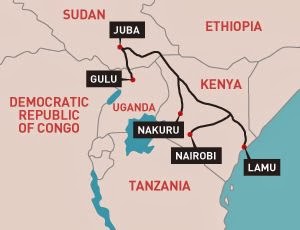
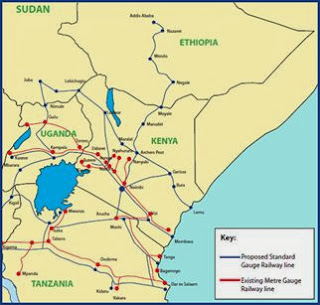
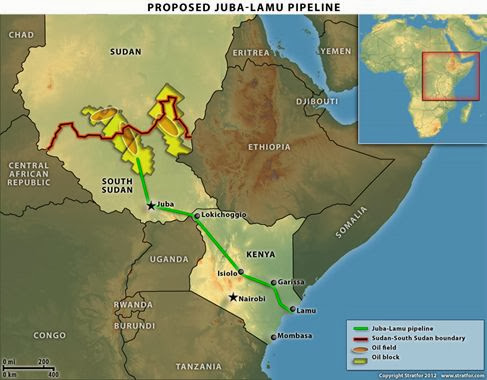
Maps of the South Sudan-Kenya oil pipeline and the South-Sudan-Ethiopia-Kenya railway, with both connecting with the port construction project at Lamu, Kenya. Comparing of the maps shows the Kenya excursion into southern Somalia creates a potential pacified buffer zone for its South Sudan-Kenya pipeline/railway projects.


USA Military aircraft fired upon by militias
News and info about the conquest of South Sudan [link]
"Evacuation operation aborted as U.S. planes come under fire in South Sudan"
2013-12-21 by Barbara Starr and Tom Watkins, CNN [http://www.cnn.com/2013/12/21/world/africa/south-sudan-violence/]:
Washington (CNN) -- A mission to evacuate Americans from South Sudan was aborted Saturday when an aircraft carrying U.S. military members was fired upon as it prepared to land in Bor, wounding four of them, the Pentagon said.
The most severely damaged aircraft was thought to have been hit in the fuel line, a military official speaking on condition of anonymity said.
All three aircraft -- CV-22 Ospreys -- were diverted to Entebbe, Uganda, which is not where their flights originated, the official said. Another aircraft then flew the wounded to Nairobi, Kenya, U.S. Africa Command said in a statement.
The four service members were in stable condition after treatment, the statement said.
Pentagon officials were trying to determine how to mount another effort to evacuate the roughly three dozen Americans in South Sudan, where they have been working for the United Nations, a senior U.S. official said on condition of anonymity.
Secretary of Defense Chuck Hagel was "reviewing options," Pentagon press secretary Rear Adm. John Kirby said. "Whatever we do it will be in coordination with the State Department," he added.
The White House said U.S. President Barack Obama was briefed before dawn Saturday while aboard Air Force One after landing in Hawaii, then met with his national security team on the matter.
The fighting has displaced as many as 100,000 people, many of whom have crossed the Nile River, he said, adding that he feared a humanitarian disaster was unfolding.
South Sudanese President Salva Kiir blamed soldiers loyal to his former vice president, Riek Machar, for starting this month's violence.
Tensions have been high in South Sudan since July, when Kiir dismissed Machar and the rest of the Cabinet. The move inflamed tensions between Kiir's Dinka community and Machar's Nuer community.
Casualties include soldiers and number in the hundreds, the government said.
U.S. Secretary of State John Kerry called Kiir on Saturday and discussed ways to halt the violence. It was Kerry's second call to Kiir since Thursday night.
"Secretary Kerry emphasized that only through leadership and political dialogue will the challenges facing South Sudan be resolved," State Department spokeswoman Jen Psaki said in a statement.
The two men "discussed the need to prevent ethnic violence, their concern for the welfare of thousands of internally displaced persons fleeing the conflict, as well as for the safety of U.S. citizens in South Sudan, and they agreed to speak again soon," she said.
Meanwhile, the State Department issued an emergency message for U.S. citizens, calling on them to avoid the area around the airport in Bor. Limited flights were continuing from Juba International Airport.
On Friday, Kerry said he was sending a special envoy -- Ambassador Donald Booth -- to the country.
"Now is the time for South Sudan's leaders to rein in armed groups under their control, immediately cease attacks on civilians, and end the chain of retributive violence between different ethnic and political groups," Kerry said in a statement.
Saturday's violence wasn't the first this week to harm foreign troops in South Sudan. On Thursday, attackers killed two Indian army peacekeepers, wounded a third, and killed two to 20 of 30 civilians who were seeking refuge at the United Nations' Akobo base, the U.N. said.
In a news release, the African Union called for an immediate truce.
It said that the chairwoman of the AU Commission, Nkosazana Dlamini-Zuma, was "profoundly dismayed at the recent turn of events" and condemned the killing of innocent civilians and U.N. peacekeepers in Bor as a war crime.
South Sudan became the world's newest country when it split from Sudan in July 2011. The split happened after a 2005 peace agreement ended years of civil war between the largely Animist and Christian south and the Muslim-dominated north.
The deal led to a January 2011 referendum in which people of the south voted to secede from Sudan.
"U.S. aircraft hit by gunfire in South Sudan as conflict worsens"
2013-12-21 by Carl Odera for "Reuters" newswire [http://www.reuters.com/article/2013/12/21/us-southsudan-unrest-aircraft-idUSBRE9BK07G20131221]:
JUBA - Three U.S. aircraft came under fire from unidentified forces on Saturday while trying to evacuate Americans from a spiraling conflict in South Sudan. The U.S. military said four of its members were wounded in the attacks.
Nearly a week of fighting in South Sudan threatens to drag the world's newest country into a Dinka-Nuer ethnic civil war just two years after it won independence from Sudan with strong support from successive U.S. administrations.
The U.S. aircraft came under fire while approaching the evacuation site, the military's Africa Command said in a statement. "The aircraft diverted to an airfield outside the country and aborted the mission," it added.
The statement said all of the three Osprey CV-22 aircraft involved in the mission had been damaged.
Consequently, U.S. President Barack Obama warned that any move to take power by military means would lead to an end of U.S. and international community support for South Sudan.
The United Nations mission in South Sudan said one of four U.N. helicopters sent to Youai, in Jonglei state, had come under small-arms fire on Friday. No crew or passengers were harmed.
Hundreds of people have been killed in the fighting between Dinka loyalists of President Salva Kiir and Nuer supporters of former Vice-President Riek Machar, who was sacked in July and is accused by the government of trying to seize power.
Fighting has spread from the capital, Juba, to vital oilfields and the government said a senior army commander had defected to Machar in the oil-producing Unity State.
The German military said on Saturday it had evacuated 98 people, including Germans and other nationals, from South Sudan by air to neighboring Uganda. The German ambassador to South Sudan was among them, the Foreign Ministry in Berlin said.
A separate plane took Lieutenant-General Hans-Werner Fritz, chief of Germany's Operations Command, along with his aides and five other Germans, to Berlin, the military said.
After meeting African mediators on Friday, Kiir's government said on its Twitter feed that it was willing to hold talks with any rebel group. The United States is sending an envoy to help find a negotiated solution.
South Sudan's foreign minister, Barnaba Marial Benjamin, told Reuters the government had given African mediators the go-ahead to meet Kiir's rivals, including Machar and his allies.
Ethiopia's Foreign Minister Tedros Adhanom, who led an East African delegation of foreign ministers in Juba aimed at mediating between the feuding sides, said the team did not manage to meet Riek Machar face to face, neither did they make phone contact.
"We are trying to contact them. We are hopeful of having both sides on the negotiating table within the space of 10 days," Tedros told Reuters.
In their meeting with Kiir, Tedros said they were also aiming to get humanitarian aid to afflicted populations unhindered.
CEASEFIRE CALL -
Benjamin said Lieutenant-General Lazarus Sumbeiywo, sent to South Sudan by Kenyan President Uhuru Kenyatta, had stayed behind along with a Kenyan diplomat after the African mediators left on Saturday and would work on making contact with Machar.
Sumbeiywo was the chief mediator in the talks that led to the signing of the 2005 peace agreements with north Sudan.
"So on the side of the government ... we have established dialogue without any condition," Benjamin said. "All we say, we urge former Vice-President Riek Machar not to incite the people of South Sudan through ethnic configuration."
United Nations staff say hundreds of people have been killed across the country, which is the size of France, this week and that 35,000 civilians are sheltering at U.N. bases.
The United Nations said on Friday at least 11 Dinka civilians had been killed during an attack by about 2,000 armed youths from another ethnic group on a U.N. peacekeeping base in Jonglei state. Two Indian peacekeepers were also killed.
The African Union called on Saturday for a Christmas ceasefire, and its chairwoman Nkosazana Dlamini-Zuma described the killings of civilians and U.N. peacekeepers as a war crime.
Reuters television footage showed several hundred government troops leaving Juba to deploy in Jonglei state.
Toby Lanzer, the U.N. Humanitarian Coordinator in South Sudan, said via Twitter that Bor, in Jonglei state, remained tense. "We've heard clashes & seen bodies in the streets. Civilians have left town to flee for their safety," he wrote.
Information Minister Michael Makuei told Reuters an army divisional commander in Unity State, John Koang, had defected and joined Machar, who had named him the governor of the state.
Jacob Dut, a political science lecturer at the University of Juba, said most army divisions had between 10,000 and 13,000 troops, although not all were fully manned.
"Division 4 (Koang's unit) is adjacent to the border with Sudan. That means there is more military hardware and that means that this defection is a big loss," Dut said.
"Evacuation operation aborted as U.S. planes come under fire in South Sudan"
2013-12-21 by Barbara Starr and Tom Watkins, CNN [http://www.cnn.com/2013/12/21/world/africa/south-sudan-violence/]:
Washington (CNN) -- A mission to evacuate Americans from South Sudan was aborted Saturday when an aircraft carrying U.S. military members was fired upon as it prepared to land in Bor, wounding four of them, the Pentagon said.
The most severely damaged aircraft was thought to have been hit in the fuel line, a military official speaking on condition of anonymity said.
All three aircraft -- CV-22 Ospreys -- were diverted to Entebbe, Uganda, which is not where their flights originated, the official said. Another aircraft then flew the wounded to Nairobi, Kenya, U.S. Africa Command said in a statement.
The four service members were in stable condition after treatment, the statement said.
Pentagon officials were trying to determine how to mount another effort to evacuate the roughly three dozen Americans in South Sudan, where they have been working for the United Nations, a senior U.S. official said on condition of anonymity.
Secretary of Defense Chuck Hagel was "reviewing options," Pentagon press secretary Rear Adm. John Kirby said. "Whatever we do it will be in coordination with the State Department," he added.
The White House said U.S. President Barack Obama was briefed before dawn Saturday while aboard Air Force One after landing in Hawaii, then met with his national security team on the matter.
The fighting has displaced as many as 100,000 people, many of whom have crossed the Nile River, he said, adding that he feared a humanitarian disaster was unfolding.
South Sudanese President Salva Kiir blamed soldiers loyal to his former vice president, Riek Machar, for starting this month's violence.
Tensions have been high in South Sudan since July, when Kiir dismissed Machar and the rest of the Cabinet. The move inflamed tensions between Kiir's Dinka community and Machar's Nuer community.
Casualties include soldiers and number in the hundreds, the government said.
U.S. Secretary of State John Kerry called Kiir on Saturday and discussed ways to halt the violence. It was Kerry's second call to Kiir since Thursday night.
"Secretary Kerry emphasized that only through leadership and political dialogue will the challenges facing South Sudan be resolved," State Department spokeswoman Jen Psaki said in a statement.
The two men "discussed the need to prevent ethnic violence, their concern for the welfare of thousands of internally displaced persons fleeing the conflict, as well as for the safety of U.S. citizens in South Sudan, and they agreed to speak again soon," she said.
Meanwhile, the State Department issued an emergency message for U.S. citizens, calling on them to avoid the area around the airport in Bor. Limited flights were continuing from Juba International Airport.
On Friday, Kerry said he was sending a special envoy -- Ambassador Donald Booth -- to the country.
"Now is the time for South Sudan's leaders to rein in armed groups under their control, immediately cease attacks on civilians, and end the chain of retributive violence between different ethnic and political groups," Kerry said in a statement.
Saturday's violence wasn't the first this week to harm foreign troops in South Sudan. On Thursday, attackers killed two Indian army peacekeepers, wounded a third, and killed two to 20 of 30 civilians who were seeking refuge at the United Nations' Akobo base, the U.N. said.
In a news release, the African Union called for an immediate truce.
It said that the chairwoman of the AU Commission, Nkosazana Dlamini-Zuma, was "profoundly dismayed at the recent turn of events" and condemned the killing of innocent civilians and U.N. peacekeepers in Bor as a war crime.
South Sudan became the world's newest country when it split from Sudan in July 2011. The split happened after a 2005 peace agreement ended years of civil war between the largely Animist and Christian south and the Muslim-dominated north.
The deal led to a January 2011 referendum in which people of the south voted to secede from Sudan.
"U.S. aircraft hit by gunfire in South Sudan as conflict worsens"
2013-12-21 by Carl Odera for "Reuters" newswire [http://www.reuters.com/article/2013/12/21/us-southsudan-unrest-aircraft-idUSBRE9BK07G20131221]:
JUBA - Three U.S. aircraft came under fire from unidentified forces on Saturday while trying to evacuate Americans from a spiraling conflict in South Sudan. The U.S. military said four of its members were wounded in the attacks.
Nearly a week of fighting in South Sudan threatens to drag the world's newest country into a Dinka-Nuer ethnic civil war just two years after it won independence from Sudan with strong support from successive U.S. administrations.
The U.S. aircraft came under fire while approaching the evacuation site, the military's Africa Command said in a statement. "The aircraft diverted to an airfield outside the country and aborted the mission," it added.
The statement said all of the three Osprey CV-22 aircraft involved in the mission had been damaged.
Consequently, U.S. President Barack Obama warned that any move to take power by military means would lead to an end of U.S. and international community support for South Sudan.
The United Nations mission in South Sudan said one of four U.N. helicopters sent to Youai, in Jonglei state, had come under small-arms fire on Friday. No crew or passengers were harmed.
Hundreds of people have been killed in the fighting between Dinka loyalists of President Salva Kiir and Nuer supporters of former Vice-President Riek Machar, who was sacked in July and is accused by the government of trying to seize power.
Fighting has spread from the capital, Juba, to vital oilfields and the government said a senior army commander had defected to Machar in the oil-producing Unity State.
The German military said on Saturday it had evacuated 98 people, including Germans and other nationals, from South Sudan by air to neighboring Uganda. The German ambassador to South Sudan was among them, the Foreign Ministry in Berlin said.
A separate plane took Lieutenant-General Hans-Werner Fritz, chief of Germany's Operations Command, along with his aides and five other Germans, to Berlin, the military said.
After meeting African mediators on Friday, Kiir's government said on its Twitter feed that it was willing to hold talks with any rebel group. The United States is sending an envoy to help find a negotiated solution.
South Sudan's foreign minister, Barnaba Marial Benjamin, told Reuters the government had given African mediators the go-ahead to meet Kiir's rivals, including Machar and his allies.
Ethiopia's Foreign Minister Tedros Adhanom, who led an East African delegation of foreign ministers in Juba aimed at mediating between the feuding sides, said the team did not manage to meet Riek Machar face to face, neither did they make phone contact.
"We are trying to contact them. We are hopeful of having both sides on the negotiating table within the space of 10 days," Tedros told Reuters.
In their meeting with Kiir, Tedros said they were also aiming to get humanitarian aid to afflicted populations unhindered.
CEASEFIRE CALL -
Benjamin said Lieutenant-General Lazarus Sumbeiywo, sent to South Sudan by Kenyan President Uhuru Kenyatta, had stayed behind along with a Kenyan diplomat after the African mediators left on Saturday and would work on making contact with Machar.
Sumbeiywo was the chief mediator in the talks that led to the signing of the 2005 peace agreements with north Sudan.
"So on the side of the government ... we have established dialogue without any condition," Benjamin said. "All we say, we urge former Vice-President Riek Machar not to incite the people of South Sudan through ethnic configuration."
United Nations staff say hundreds of people have been killed across the country, which is the size of France, this week and that 35,000 civilians are sheltering at U.N. bases.
The United Nations said on Friday at least 11 Dinka civilians had been killed during an attack by about 2,000 armed youths from another ethnic group on a U.N. peacekeeping base in Jonglei state. Two Indian peacekeepers were also killed.
The African Union called on Saturday for a Christmas ceasefire, and its chairwoman Nkosazana Dlamini-Zuma described the killings of civilians and U.N. peacekeepers as a war crime.
Reuters television footage showed several hundred government troops leaving Juba to deploy in Jonglei state.
Toby Lanzer, the U.N. Humanitarian Coordinator in South Sudan, said via Twitter that Bor, in Jonglei state, remained tense. "We've heard clashes & seen bodies in the streets. Civilians have left town to flee for their safety," he wrote.
Information Minister Michael Makuei told Reuters an army divisional commander in Unity State, John Koang, had defected and joined Machar, who had named him the governor of the state.
Jacob Dut, a political science lecturer at the University of Juba, said most army divisions had between 10,000 and 13,000 troops, although not all were fully manned.
"Division 4 (Koang's unit) is adjacent to the border with Sudan. That means there is more military hardware and that means that this defection is a big loss," Dut said.
Thursday, December 19, 2013
USA Federal Diplomats sent to Central African Republic
News and info about the imperialist conquest in the Central Africa Republic [link]
"Top U.S. Officials Fly to Central African Republic"
2013-12-19 by Chris Good [http://abcnews.go.com/blogs/headlines/2013/12/top-u-s-officials-fly-to-central-african-republic/]:
Two top U.S. diplomatic officials are flying to the war-torn Central African Republic this morning, marking the highest-level U.S. visit there since the country devolved into chaos that has left hundreds dead in the past weeks.
U.S. Ambassador to the United Nations Samantha Power and Assistant Secretary of State for African Affairs Linda Thomas-Greenfield are slated to land in the Central African Republic (CAR) capital of Bangui at 3 a.m. ET, 9 a.m. local, Power told reporters on Tuesday, noting that the people of CAR “are in profound danger.”
The two will meet with government and religious leaders to press for peace and security as international troops confront an alarming situation, with Muslim and Christian militias engaged in widespread religious reprisal killings.
“President Obama, Secretary [of State John] Kerry and I have all been deeply disturbed by reports of ongoing brutality in the Central African Republic,” Power told reporters on a conference call Tuesday. Media outlets agreed not to publish her comments until her scheduled landing in the country.
“Mobs have been going door to door,” Power said. “Urgent action is required to save lives.”
Last week alone, over 600 people were killed across CAR and 159,000 driven from their homes in Bangui, the United Nations office of the high commissioner for human rights said on Friday.
“The situation in the Central African Republic is both desperate and extremely dynamic and volatile,” Power said. “My government is thankful to the French and the brave African troops for putting their lives at risk.”
Power spoke by phone with transitional president Michel Djotodia on Dec. 8. Djotodia has said he cannot control the rebels that helped usher him into power earlier this year.
In March, largely Muslim rebels known as the Seleka seized Bangui, and rebel leader Djotodia dissolved the constitution and became transitional president. Responding to religious violence perpetrated by ex-Seleka fighters, Christian communities formed “anti-balaka,” or “anti-machete,” militias, and religious reprisal killings ensued, with Christian and Muslim communities both driven into hiding by militias. Of CAR’s 4.6 million population–half of whom are children, according to the U.N. — about 10 percent have been displaced.
Human rights violations have been widespread. A Nov. 15 United Nations report cited “summary executions, sexual and gender-based violence, torture, illegal arrests and detentions, looting of property, illegal checkpoints and extortion.” Sexual violence against women and girls has gone on “with absolute impunity,” U.N. reported.
International troops are seeking to disarm rebels and restore order. This month, the United Nations Security Council authorized 1,500 French troops and 3,600 African Union troops to confront and disarm rebels. The African force will be expanded to 6,000, meaning a total of 7,500 international troops will be in CAR. The U.S. military has helped deploy African troops, flying C-130 transport planes to and from Burundi to move soldiers into CAR.
The U.S. has authorized $100 million to support the international forces with supplies and trucks. On Dec. 10, President Obama augmented an initial $40 million with $60 million in added Department of Defense funds. The U.S. Agency for International Development (USAID) has given a total of $24.6 million in humanitarian assistance.
"Top U.S. Officials Fly to Central African Republic"
2013-12-19 by Chris Good [http://abcnews.go.com/blogs/headlines/2013/12/top-u-s-officials-fly-to-central-african-republic/]:
Two top U.S. diplomatic officials are flying to the war-torn Central African Republic this morning, marking the highest-level U.S. visit there since the country devolved into chaos that has left hundreds dead in the past weeks.
U.S. Ambassador to the United Nations Samantha Power and Assistant Secretary of State for African Affairs Linda Thomas-Greenfield are slated to land in the Central African Republic (CAR) capital of Bangui at 3 a.m. ET, 9 a.m. local, Power told reporters on Tuesday, noting that the people of CAR “are in profound danger.”
The two will meet with government and religious leaders to press for peace and security as international troops confront an alarming situation, with Muslim and Christian militias engaged in widespread religious reprisal killings.
“President Obama, Secretary [of State John] Kerry and I have all been deeply disturbed by reports of ongoing brutality in the Central African Republic,” Power told reporters on a conference call Tuesday. Media outlets agreed not to publish her comments until her scheduled landing in the country.
“Mobs have been going door to door,” Power said. “Urgent action is required to save lives.”
Last week alone, over 600 people were killed across CAR and 159,000 driven from their homes in Bangui, the United Nations office of the high commissioner for human rights said on Friday.
“The situation in the Central African Republic is both desperate and extremely dynamic and volatile,” Power said. “My government is thankful to the French and the brave African troops for putting their lives at risk.”
Power spoke by phone with transitional president Michel Djotodia on Dec. 8. Djotodia has said he cannot control the rebels that helped usher him into power earlier this year.
In March, largely Muslim rebels known as the Seleka seized Bangui, and rebel leader Djotodia dissolved the constitution and became transitional president. Responding to religious violence perpetrated by ex-Seleka fighters, Christian communities formed “anti-balaka,” or “anti-machete,” militias, and religious reprisal killings ensued, with Christian and Muslim communities both driven into hiding by militias. Of CAR’s 4.6 million population–half of whom are children, according to the U.N. — about 10 percent have been displaced.
Human rights violations have been widespread. A Nov. 15 United Nations report cited “summary executions, sexual and gender-based violence, torture, illegal arrests and detentions, looting of property, illegal checkpoints and extortion.” Sexual violence against women and girls has gone on “with absolute impunity,” U.N. reported.
International troops are seeking to disarm rebels and restore order. This month, the United Nations Security Council authorized 1,500 French troops and 3,600 African Union troops to confront and disarm rebels. The African force will be expanded to 6,000, meaning a total of 7,500 international troops will be in CAR. The U.S. military has helped deploy African troops, flying C-130 transport planes to and from Burundi to move soldiers into CAR.
The U.S. has authorized $100 million to support the international forces with supplies and trucks. On Dec. 10, President Obama augmented an initial $40 million with $60 million in added Department of Defense funds. The U.S. Agency for International Development (USAID) has given a total of $24.6 million in humanitarian assistance.
Subscribe to:
Posts (Atom)