Tuesday, May 13, 2014

AFRICOM conducts operations against Caliphate vanguard Boko Haram in Nigeria


"Western intervention will turn Nigeria into an African Afghanistan; 
The plight of kidnapped girls is set against the corruption and inequality that the west's economic war has helped to create"
2014-05-06 by Lindsey German for "theguardian.com" [http://www.theguardian.com/commentisfree/2014/may/06/western-intervention-nigeria-kidnapped-girls-corruption-boko-haram]:
'There is widespread corruption, yet weapons and armies are paid to protect the wealthy and the foreign companies like Shell that want to access the country’s resources, especially oil.' Photograph by George Esiri/EPA, showing 2011 protest against Shell after a oil spill from a Shell oil field in Nigeria

It seems almost beyond belief that more than 200 girls can be kidnapped from a school in northern Nigeria, held by the terrorist group Boko Haram, and threatened on a video – shown worldwide – with being sold into slavery by their captors. The disbelief is compounded by today's news that, overnight, eight more girls have been kidnapped by suspected Boko Haram gunmen in north-east Nigeria. This tragedy touches the hearts of everyone, evoking a feeling of revulsion not only at the danger and loss of freedom itself, but at the assumption that for young girls their destination must be forced marriage and servitude, not education.
There is rightly anger that so little has been done by the Nigerian government to find the girls, and that those who have demonstrated in huge numbers against President Goodluck Jonathan have themselves been accused of causing trouble or even temporarily arrested.
But we should be wary of the narrative now emerging. This follows a wearily familiar pattern, one we have already seen in south Asia and the Middle East, but that is increasingly being applied to Africa as well.
It is the refrain that something must be done and that "we" – the enlightened west – must be the people to do it. As the US senator Amy Klobuchar put it: "This is one of those times when our action or inaction will be felt not just by those schoolgirls being held captive and their families waiting in agony, but by victims and perpetrators of trafficking around the world. Now is the time to act."
The call has been for western intervention to help find the girls, and to help "stabilise" Nigeria in the aftermath of their kidnap. The British government has offered "practical help".
Yet western intervention has time and again failed to deal with particular problems and – worse – has led to more deaths, displacements and atrocities than were originally faced. All too often it has been justified with reference to women's rights, claiming that enlightened military forces can create an atmosphere where women are free from violence and abuse. The evidence is that the opposite is the case.
Women's rights were a major justification for the Afghanistan war, launched in 2001, when Cherie Blair and Laura Bush supported their husbands' war as a means of liberating Afghan women. Today, with millions displaced and tens of thousands dead, Afghanistan remains one of the worst countries on earth for women to live, with forced marriage, child marriage, rape and other atrocities still occurring widely.
And western intervention is already firmly embedded in Africa. It does not have the same profile as in Afghanistan or Iraq, because past wars have made it harder to put boots on the ground. But Barack Obama has his military forces engaged in West Africa through their Predator drone base in Niger, which borders northern Nigeria. It also borders Mali, the scene of recent French and British interventions, and Libya, object of a disastrous western bombing campaign in 2011 that has left that country in a state of civil war and collapse.
US drones also operate in Djibouti, Ethiopia and just across the Red Sea in Yemen. The west has been engaged in proxy wars in Somalia in recent years.
If Islamism is now a threat to western interests in growing parts of Africa, it is one that they have played a large part in creating.
But there is another war going on in Africa: economic war. A continent so rich in natural resources sees many of its citizens live in terrible conditions. In President Jonathan's Nigeria, economic growth has not trickled down to the poor. Healthcare and education are beyond the reach of many.
There is widespread corruption, yet weapons and armies are paid to protect the wealthy and the foreign companies, such as Shell, that want to access the country's resources, especially oil. This corruption and inequality is not separate from the role of the west, but an integral part of a system that is prepared to go to war over resources such as oil and gas, but will not go to war on poverty or to provide education for all.
It is this background that informs the terrible plight of the kidnapped girls in Nigeria. It will not be improved by more western weapons and armies on the ground or in the air.


"AFRICOM Chief to Aid Search for Nigerian Schoolgirls"
2014-05-13 from "AGENCE FRANCE-PRESSE (AFP)" newswire:
A screengrab taken from a video released May 12 by Nigerian Islamist extremist group Boko Haram shows girls wearing the full-length hijab holding a flag reading 'There is no god, but Allah' and 'Mohammed is Allah's prophet' at an undisclosed rural location. (AFP)
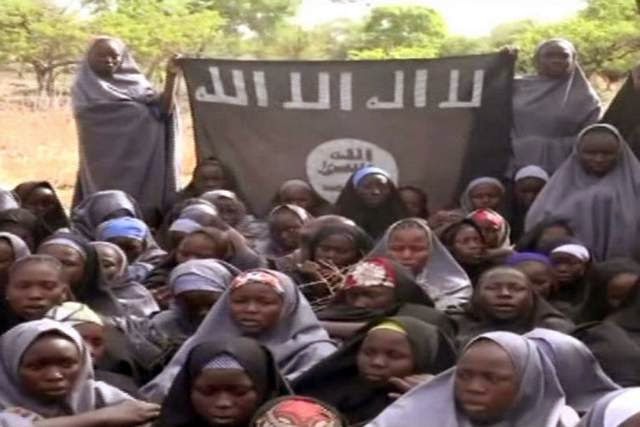
ABUJA, NIGERIA — The commander of US forces in Africa held talks Tuesday in Nigeria as Washington sought to help the government in Abuja trace more than 200 schoolgirls kidnapped by Islamist militants.
Gen. David Rodriguez, head of US Africa Command, flew to Nigeria on Monday as the United States confirmed it was flying manned surveillance aircraft over the country and sharing commercial satellite imagery to aid the hunt for the abducted girls.
The talks are focused in part on forging an agreement that will enable the United States to share intelligence with Nigeria from spy planes and other sources, officials said Tuesday.
“At this point, we are not sharing the raw intelligence data” Pentagon spokesman Col. Steven Warren told reporters.
“We are working closely with the Nigerians to establish intelligence sharing protocols,” he said.
The US government insists on elaborate safeguards to govern intelligence sharing with other countries, fearing that sensitive information could fall into an adversary’s hands.
The United States already has deployed a team of 30 specialists from different agencies, including 16 military personnel, to help in the search for the kidnapped schoolgirls.
“We’re playing a supporting role and bringing our capabilities and expertise to bear ... in complementing their efforts,” State Department spokeswoman Jen Psaki said.
As Nigeria faced a “difficult mission” searching a vast area, the team was designed to “provide military and law enforcement assistance as well as intelligence, surveillance and reconnaissance support,” she said.
The US general’s trip to the country was scheduled prior to the crisis and Rodriguez also was discussing the US military’s long-term relations with Nigerian forces, officials said.
A defense official told AFP that Rodriguez “is discussing US assistance for the search as well as overall cooperation.”
The four-star general held talks with Nigerian civilian and military officials, including Air Chief Marshal Alex Badeh, chief of the defense staff, according to Nigeria’s defense ministry.
Badeh expressed “appreciation” to the US general on Tuesday as Washington had responded “positively” to an appeal for help in the search for the abducted schoolgirls, the ministry said in a statement.
The Nigerian military has “benefited immensely from the bilateral relationship” with the United States, receiving valuable training and hardware, it said.
Prior to the kidnapping, Nigeria showed little interest in large-scale cooperation with the US military. And Washington has harbored concerns over what it sees as heavy-handed tactics by Nigerian troops in their fight against Boko Haram militants in the north.
Boko Haram extremists abducted 276 girls from the remote northeastern town of Chibok in Borno state on April 14, and some 223 are still missing.
The militants on Monday released a new video purporting to show some of the girls.
US intelligence experts are “combing through every detail of the video for clues,” a State Department spokeswoman said on Monday.
British, French and Israeli specialists are also providing assistance to Nigeria, which has been accused of responding too slowly to the kidnapping and even of ignoring a forewarning that it was imminent.
Pentagon officials declined to rule out if Washington would provide drones to aid in the search and would not say publicly what type of manned military surveillance aircraft were flying over Nigeria.
Although some US lawmakers have called for a US military operation to rescue the girls, the Pentagon reiterated that it was not preparing any such attempt by US special operations forces.
“There’s no discussion at this point to send operators into Nigeria to conduct any kind of rescue operation,” Warren said.


"US flying drones over Nigeria in search for girls"
2014-05-14 from "AFP" newswire:
The US military is flying surveillance drones as well as manned aircraft over Nigeria to help the search for more than 200 schoolgirls kidnapped by Islamist extremists, the Pentagon said Wednesday.
However, the data is not yet being shared with the Nigerians because Washington is still working out an agreement to govern the sharing of intelligence, Colonel Steven Warren told reporters.
The United States has deployed a Global Hawk, which flies at high altitude, and the manned MC-12, a turboprop plane heavily used in Afghanistan, for the mission, a defense official who spoke on condition of anonymity told AFP.
The Pentagon had initially declined to say publicly if drones were being used.
"I can confirm that we're using both manned and unmanned aerial ISR (intelligence, surveillance and reconnaissance) assets in the search for the kidnapped girls," Warren said, without identifying the plane models.
Both types of aircraft are "unarmed" and being used strictly for surveillance to help track the location of the schoolgirls whose plight has made worldwide headlines, he added.
The unmanned Global Hawk, designed to succeed the U-2 spy plane, can survey a vast area of about 40,000 square miles (100,000 square kilometers) in a day with its sophisticated radar and sensors.
But the Americans insist on precise protocols on how intelligence can be passed on to other countries, fearing that sensitive information could fall into an adversary's hands.
The commander of US forces in Africa, General David Rodriguez, paid a two-day visit to Nigeria this week to discuss how Washington can aid the government in the kidnapping crisis, including an accord on intelligence sharing.
Boko Haram extremists abducted 276 girls from the remote northeastern town of Chibok on April 14, and some 223 are still missing.
The kidnapping has triggered global outrage and the militants on Monday released a new video purporting to show some of the girls.
"We are continuing to work with the Nigerians to help locate the girls. We really don't know where the girls are," said a senior State Department official who spoke on condition of anonymity.
The area to be searched was "vast" and ideas about what may have happened to the girls remained "speculation," the official said.

- Limited relations -
The United States was also conferring with neighboring countries and "those governments too are in communication with the Nigerians because they've all been engaged to try to figure out how to help with the search for the girls," the official said.
Prior to the kidnapping, the US military had only limited relations with the Nigerian armed forces, which has included training on detecting and defusing homemade bombs.
Security ties have been hampered partly due to Washington's concerns over heavy-handed tactics and human rights abuses by Nigerian troops battling militants in the northeast.
The State Department official acknowledged the issue, saying "we've been very clear about our concerns about... reports of and evidence of (rights) abuses and excessive violations of the Nigerian military."
Washington has urged the Nigerian government "to hold violators accountable."
Under US law, the American government faces restrictions on its security cooperation with foreign military units linked to human rights abuses.
As a result, the United States cannot work with a particular Nigerian counter-terrorism unit, the official said.
Hawkish Republican Senator John McCain said the Pentagon should consider acting unilaterally and sending US special forces in to rescue the girls.
"We're the best-trained, most professional military in the world, and if we know where these young girls are, we should go rescue them," McCain told reporters.
McCain mocked the capabilities of Nigeria's military and said any special forces entry should be done without their knowledge.
"You don't want to alert these people," he said of Boko Haram. "These are animals. They are outside the boundaries of human acceptable behavior."
US military officials said privately that a rescue mission would be fraught with massive risks and dangers and that it currently was not deemed an option.

Monday, May 12, 2014

Nigeria to send workers to Korea to be trained in energy extraction processes


"Nigerians will be put to work building the country's gas industry; Nearly 200 workers will be sent to South Korea for training program"
2014-05-12 by Daniel J. Graeber from "UPI" [http://www.upi.com/Business_News/Energy-Resources/2014/05/12/Nigeria-lays-labor-groundwork-for-LNG/4561399901252]:
Nigeria's efforts to reduce flaring from production tied to its natural gas reserves will empower its people, a project developer said.
State-led Nigeria LNG Ltd., though subsidiary Bonny Gas Transport Ltd., said it was sending 180 Nigerians to South Korea to learn how to build vessels used in the liquefied natural gas sector.
Last year, Bonny Gas Transport ordered six vessels to advance Nigerian efforts to build up its LNG capacity.
Nigerian LNG Ltd. Managing Director Babs Omotowa said using the local labor pool for the projects will help "Nigerianize" the country's gas sector.
"Every action we take in Nigeria LNG Limited, we seek to help build a better Nigeria," he said in a statement Sunday.
The Nigerian company will send 180 technicians to South Korea for the three-month program. Of them, 28 will be employed for LNG vessel construction.
Nigeria Ltd. says it's the "arrow-head" of the government's effort to reduce flaring and derive value from the 187 trillion cubic feet of proven natural gas reserves in the country.

EU charter petroleum companies preparing to develop Virunga National Park in DRC, death-squad actions described against advocates for preservation of park


" 'Death threats' for WWF staff opposing UK oil firm in DR Congo park"
2014-05-12 from "AFP" newswire:
The World Wildlife Fund on Monday condemned "death threats" against two of its staff fighting oil exploration in a Democratic Republic of Congo nature park just weeks after the park's director was shot.
"Unidentified callers have threatened the personal safety of two employees working in the city of Goma," WWF said in a statement.
The staff have been involved in efforts to block oil exploration by UK company Soco International PLC in nearby Virunga National Park, an 800,000-hectare nature reserve that is among the oldest in Africa and home to rare and endangered mountain gorillas.
Referring to one of the campaigners, a threatening caller said, "We want his head," according to WWF.
The organisation said there had been an increase in intimidating calls, text messages and notes since the park's director Emmanuel de Merode was shot several times while driving in the region in April.
"The callers to WWF said that they had missed killing de Merode, but would not miss WWF's employee," the organisation said. "WWF insists that authorities in DRC do everything in their power to bring the perpetrators of these threats and de Merode's attack to justice."
There has been mounting worldwide opposition to oil exploration in Virunga, a UNESCO world heritage site that is thought to have the greatest biodiversity on the continent.
The UK government, Nobel laureate Desmond Tutu, and Virgin's Richard Branson have all spoken out against Soco's operations, which have recently involved seismic tests in Lake Edward
UNESCO says exploration would breach international conventions on protecting world heritage, to which DRC is a signatory.
But it fears laws could be changed by the Congolese government to allow oil concessions covering 85 percent of the park's territory to be exploited. Exploration permits have already been distributed to international firms, including Soco and France's Total.
Soco's deputy director Roger Cagle told AFP that the firm had been "informed of the news that two employees of the NGO ... were threatened as a result of their opposition to oil development.
"Soco condemns this behaviour and does not tolerate any act of threat or intimidation."
Local activists told AFP in October that they received regular threats bordering on harassment.

Thursday, May 8, 2014

USA CIA's African Rendition Network, w. politically motivated kidnappings and assassinations

"Newly Released Documents Shed Light on CIA’s African Rendition Network"
2014-05-08 from "Reprieve" [http://www.commondreams.org/newswire/2014/05/08]:
Reprieve is a UK-based human rights organization that uses the law to enforce the human rights of prisoners, from death row to Guantánamo Bay.
---
LONDON - Documents released by Reprieve and New York University’s Global Justice Clinic have shed new light on the CIA’s African rendition network. The documents show how planes contracted by the US government for rendition missions used Djibouti as a hub.
The documents support a complaint by a Yemeni national, Mohammed al-Asad, that he was snatched from his family home in Tanzania and detained in several secret CIA locations in Djibouti and Afghanistan. Mr al-Asad’s case is currently being considered by the African Commission on Human and Peoples’ Rights. It comes at a time of renewed scrutiny of the US secret prison programme, owing to the imminent declassification of part of the Senate Intelligence Committee’s report on CIA torture. Al Jazeera last week revealed that the Senate’s investigation concluded that several people had been secretly detained in Djibouti.
Reprieve has uncovered legal and contractual documents, which show how a group of US companies (including Computer Sciences Corporation, DynCorp Systems and Solutions, Richmor Aviation and First Flight) worked together to provide support to the CIA’s torture programme. Matching invoice and contract numbers show that several trips through Djibouti in 2003 and 2004 were undertaken on behalf of the US government with State Department authorization. According to court filings by contractors involved in the flights, trips performed on these contracts were used for access to Guantánamo Bay and “assorted rendition missions”.
Aside from its role as a rendition hub, Djibouti has also gained prominence as a base for US targeted killing missions. Camp Lemonnier in Djibouti has been described by The Economist as “the most important base for drone operations outside the war zone of Afghanistan”. From Lemonnier, American drones take off to carry out strikes in Yemen that have been heavily criticized by the international human rights community.
Mr al-Asad’s case is the first of its kind in the African human rights system. After being held in Djibouti he was transferred to Afghanistan and abused there for over a year. He was subsequently released and has never been charged with a terrorism-related crime.
Kevin Lo, CSR Advocate at Reprieve, said: “These documents provide further evidence of how US corporations played a crucial role in the CIA’s torture network, rendering people to torture around the world far from public scrutiny and even further from the rule of law. Corporate complicity by the British companies must also be brought to light. BT has refused to answer important questions over its role in facilitating the devastating US covert drone programme waged in Yemen from a secretive base in Djibouti. Corporations cannot pretend to be ignorant of how their products result in the deaths of innocent civilians."
Margaret Satterthwaite of NYU’s Global Justice Clinic said: “These contracts and Reprieve’s analysis add to the growing documentation of Djibouti's role in the torture programme. The evidence has become overwhelming that Djibouti was a hub for CIA renditions.”

Monday, May 5, 2014

USA Dept. of State sends John Kerry to Angola to announce full support to energy extraction operations by USA charter companies


"Angola's potential 'enormous,' U.S. Secretary of State Kerry says"
2014-05-05 by Daniel J. Graeber for "UPI" newswire [http://www.upi.com/Business_News/Energy-Resources/2014/05/05/Kerry-oil-majors-see-bright-future-for-Angola/6721399299871/]:
Some of the biggest energy companies in the world are in Angola to the benefit of the nation's economy, U.S. Secretary of State John Kerry said.
Kerry arrived Sunday in Angola during his tour of African nations, and met there with representatives from Chevron, Exxon Mobil and ConocoPhillips to hear their energy strategies in the country.
Chevron, a new player in the Angolan energy sector, has already created more than 3,000 jobs in the country, the secretary said.
"We're standing in a place of enormous economic activity with great promise for future economic growth and development," he said in a statement.
Last month, French energy company Total said it would invest $16 billion in development the Kaombo oil project off the Angolan coast.
The field, which has an estimated 650 million barrels of reserves, should produce 230,000 barrels of oil per day for Angola once operations begin.
Angola is a member of the Organization of Petroleum Exporting Countries. It has 9 billion barrels of proven crude oil reserves and produces on average 1.7 million bpd.

Sunday, April 13, 2014

AFRICOM lies to news media about mission, but is upfront to EU & USA charter weapons companies

"AFRICOM Becomes a 'War-Fighting Combatant Command' "
2014-04-13 intro by Tom Dispatch for "AFRICOM Goes to War on the Sly: U.S. Officials Talk Candidly (Just Not to Reporters) about Bases, Winning Hearts and Minds, and the “War” in Africa" article by Nick Turse for "Tom Dispatch" [http://www.tomdispatch.com/blog/175830]:
Let me explain why writing the introduction to today’s post by TomDispatch Managing Editor Nick Turse is such a problem.  In these intros, I tend to riff off the ripples of news that regularly surround whatever subject an author might be focusing on.  So when it comes to the U.S. military, if you happen to be writing about the Obama administration’s “pivot to Asia,” really, no problem.  Background pieces on that pile up daily.  How could you resist, for instance, saying something about the U.S. refusal to send an aircraft carrier to China for a parade of Pacific fleets (after the Chinese refused to allow Japanese ships to participate)?  It’s mean girls of the Pacific, no?  Have an interest in the Ukrainian crisis?  Piece of cake, top of the news any time -- like those curious pro-Russian protestors in eastern Ukraine who tried to liberate an opera house in the city of Kharkiv, mistaking it for city hall, or the hints that U.S. troops might soon be stationed in former Soviet satellite states.  Or, say, you’re writing about threats in cyberspace -- couldn’t be simpler!  Not when you have Secretary of Defense Chuck Hagel offering an amusing assurance that the country that launched the first cyberwar and is ramping up its new cybercommand at warp speed “does not seek to militarize cyberspace.” And, of course, any day of the week U.S.-Iranian relations are a walk in the park (in the dark).  At the moment, for instance, the Iranian nominee for U.N. ambassador -- previously that country’s ambassador to Belgium, Italy, Australia, and the European Union, but once a translator for the group that took U.S. embassy hostages in Tehran in 1979 -- has been declared “not viable” by the Obama administration.  In a remarkable act of congressional heroism, the U.S. Senate, led by that odd couple Ted Cruz and Chuck Schumer, has definitively banned him from setting foot in the country.  Mean girls of Washington?  Who could resist such material?
Unfortunately, there’s one place in that city’s global viewfinder that never seems to provides much of anything to riff off of, and so no fun whatsoever: Africa.  Yes, today and Tuesday, Nick Turse continues his remarkable coverage of the U.S. military pivot to that continent, which promises a lifetime of chaos and blowback to come [http://www.tomdispatch.com/blog/175714/nick_turse_blowback_central].  Admittedly, what’s happening isn’t your typical, patented, early twenty-first-century-style U.S. invasion, but it certainly represents part of a new-style scramble for Africa -- with the U.S. taking the military path and the Chinese the economic one.  By the time U.S. Africa Command is finished, however, one thing is essentially guaranteed: a terrible mess and a lifetime of hurt will be left behind. This particular pivot is happening on a startling scale and yet remains just below the American radar screen. Explain it as you will, with the rarest of exceptions the U.S. media, riveted by Obama’s so far exceedingly modest pivot to Asia, finds the African one hardly worth a moment’s notice, which is why, today, without the usual combustible mix of what’s recently in the news and what’s newsmaking in Turse’s two pieces, I have no choice but to skip the introduction.

"AFRICOM Goes to War on the Sly: U.S. Officials Talk Candidly (Just Not to Reporters) about Bases, Winning Hearts and Minds, and the “War” in Africa" 
2014-04-13 article by Nick Turse for "Tom Dispatch" [http://www.tomdispatch.com/blog/175830]:
Nick Turse is the managing editor of TomDispatch.com and a fellow at the Nation Institute.  A 2014 Izzy Award winner, his pieces have appeared in the New York Times, the Los Angeles Times, the Nation, at the BBC, and regularly at TomDispatch. He is the author most recently of the New York Times bestseller Kill Anything that Moves: The Real American War in Vietnam (just out in paperback).
---
What the military will say to a reporter and what is said behind closed doors are two very different things -- especially when it comes to the U.S. military in Africa.  For years, U.S. Africa Command (AFRICOM) has maintained a veil of secrecy about much of the command’s activities and mission locations, consistently downplaying the size, scale, and scope of its efforts.   At a recent Pentagon press conference, AFRICOM Commander General David Rodriguez adhered to the typical mantra, assuring the assembled reporters that the United States “has little forward presence” on that continent.  Just days earlier, however, the men building the Pentagon’s presence there were telling a very different story -- but they weren’t speaking with the media.  They were speaking to representatives of some of the biggest military engineering firms on the planet.  They were planning for the future and the talk was of war.
I recently experienced this phenomenon myself during a media roundtable with Lieutenant General Thomas Bostick, commander of the U.S. Army Corps of Engineers.  When I asked the general to tell me just what his people were building for U.S. forces in Africa, he paused and said in a low voice to the man next to him, “Can you help me out with that?”  Lloyd Caldwell, the Corps’s director of military programs, whispered back, “Some of that would be close hold” -- in other words, information too sensitive to reveal.
The only thing Bostick seemed eager to tell me about were vague plans to someday test a prototype “structural insulated panel-hut,” a new energy-efficient type of barracks being developed by cadets at the U.S. Military Academy at West Point.  He also assured me that his people would get back to me with answers.  What I got instead was an “interview” with a spokesman for the Corps who offered little of substance when it came to construction on the African continent.  Not much information was available, he said, the projects were tiny, only small amounts of money had been spent so far this year, much of it funneled into humanitarian projects.  In short, it seemed as if Africa was a construction backwater, a sleepy place, a vast landmass on which little of interest was happening.
Fast forward a few weeks and Captain Rick Cook, the chief of U.S. Africa Command’s Engineer Division, was addressing an audience of more than 50 representatives of some of the largest military engineering firms on the planet -- and this reporter.  The contractors were interested in jobs and he wasn’t pulling any punches.  “The eighteen months or so that I’ve been here, we’ve been at war the whole time,” Cook told them.  “We are trying to provide opportunities for the African people to fix their own African challenges.  Now, unfortunately, operations in Libya, South Sudan, and Mali, over the last two years, have proven there’s always something going on in Africa.”
Cook was one of three U.S. military construction officials who, earlier this month, spoke candidly about the Pentagon’s efforts in Africa to men and women from URS Corporation, AECOM, CH2M Hill, and other top firms.  During a paid-access web seminar, the three of them insisted that they were seeking industry “partners” because the military has “big plans” for the continent.  They foretold a future marked by expansion, including the building up of a “permanent footprint” in Djibouti for the next decade or more, a possible new compound in Niger, and a string of bases devoted to surveillance activities spreading across the northern tier of Africa.  They even let slip mention of a small, previously unacknowledged U.S. compound in Mali.

The Master Plan -
After my brush off by General Bostick, I interviewed an Army Corps of Engineers Africa expert, Chris Gatz, about construction projects for Special Operations Command Africa in 2013.  “I’ll be totally frank with you,” he said, “as far as the scopes of these projects go, I don’t have good insights.”
What about two projects in Senegal I had stumbled across?  Well, yes, he did, in fact, have information about a firing range and a “shoot house” that happened to be under construction there.  When pressed, he also knew about plans I had noted in previously classified documents obtained by TomDispatch for the Corps to build a multipurpose facility in Cameroon.  And on we went.  “You’ve got better information than I do,” he said at one point, but it seemed like he had plenty of information, too.  He just wasn’t volunteering much of it to me.
Later, I asked if there were 2013 projects that had been funded with counter-narco-terrorism (CNT) money.  “No, actually there was not,” he told me.  So I specifically asked about Niger.
Last year, AFRICOM spokesman Benjamin Benson confirmed to TomDispatch that the U.S. was conducting intelligence, surveillance, and reconnaissance, or ISR, drone operations from Base Aérienne 101 at Diori Hamani International Airport in Niamey, the capital of Niger.  In the months since, air operations there have only increased.  In addition, documents recently obtained by TomDispatch indicated that the Army Corps of Engineers has been working on two counter-narco-terrorism projects in Arlit and Tahoua, Niger.  So I told Gatz what I had uncovered.  Only then did he locate the right paperwork.  “Oh, okay, I’m sorry,” he replied.  “You’re right, we have two of them... Both were actually awarded to construction.”
Those two CNT construction projects have been undertaken on behalf of Niger’s security forces, but in his talk to construction industry representatives, AFRICOM’s Rick Cook spoke about another project there: a possible U.S. facility still to be built.  “Lately, one of our biggest focus areas is in the country of Niger.  We have gotten indications from the country of Niger that they are willing to be a partner of ours,” he said.  The country, he added, “is in a nice strategic location that allows us to get to many other places reasonably quickly, so we are working very hard with the Nigeriens to come up with, I wouldn’t necessarily call it a base, but a place we can operate out of on a frequent basis.”
Cook offered no information on the possible location of that facility, but recent contracting documents examined by TomDispatch indicate that the U.S. Air Force is seeking to purchase large quantities of jet fuel to be delivered to Niger's Mano Dayak International Airport.
Multiple requests for further information sent to AFRICOM’s media chief Benjamin Benson went unanswered, as had prior queries about activities at Base Aérienne 101.  But Colonel Aaron Benson, Chief of the Readiness Division at Air Forces Africa, did offer further details about the Nigerien mini-base.  “There is the potential to construct MILCON aircraft parking aprons at the proposed future site in Niger,” he wrote, mentioning a specific type of military construction funding dedicated to use for “enduring” bases rather than transitory facilities.  In response to further questions, Cook referred to the possible site as a “base-like facility” that would be “semi-permanent” and “capable of air operations.”

Pay to Play -
It turns out that, if you want to know what the U.S. military is doing in Africa, it’s advantageous to be connected to a large engineering or construction firm looking for business.  Then you’re privy to quite a different type of insider assessment of the future of the U.S. presence there, one far more detailed than the modest official pronouncements that U.S. Africa Command offers to journalists.  Asked at a recent Pentagon press briefing if there were plans for a West African analog to Djibouti’s Camp Lemonnier, the only "official" U.S. base on the continent, AFRICOM Commander General David Rodriguez was typically guarded.  Such a “forward-operating site” was just “one of the options” the command was mulling over, he said, before launching into the sort of fuzzy language typical of official answers.  “What we're really looking at doing is putting contingency locating sites, which really have some just expeditionary infrastructure that can be expanded with tents,” was the way he put it.  He never once mentioned Niger, or airfield improvements, or the possibility of a semi-permanent "presence.”
Here, however, is the reality as we know it today.  Over the last several years, the U.S. has been building a constellation of drone bases across Africa, flying intelligence, surveillance, and reconnaissance missions out of not only Niger, but also Djibouti, Ethiopia, and the island nation of the Seychelles.  Meanwhile, an airbase in Ouagadougou, the capital of Burkina Faso, serves as the home of a Joint Special Operations Air Detachment, as well as of the Trans-Sahara Short Take-Off and Landing Airlift Support initiative.  According to military documents, that “initiative” supports “high-risk activities” carried out by elite forces from Joint Special Operations Task Force-Trans Sahara.  U.S. Army Africa documents obtained by TomDispatch also mention the deployment to Chad of an ISR liaison team.  And according to Sam Cooks, a liaison officer with the Defense Logistics Agency, the U.S. military has 29 agreements to use international airports in Africa as refueling centers.
U.S. Facility near Gao, Mali.  This austere compound is thought to have been overrun by Islamist forces in 2012.  Credit: U.S. Army Corps of Engineers.

As part of the webinar for industry representatives, Wayne Uhl, chief of the International Engineering Center for the Europe District of the Army Corps of Engineers, shed light on shadowy U.S. operations in Mali before (and possibly after) the elected government there was overthrown in a 2012 coup led by a U.S.-trained officer.  Documents prepared by Uhl reveal that an American compound was constructed near Gao, a major city in the north of Mali.  Gao is the site of multiple Malian military bases and a “strategic” airport captured by Islamist militants in 2012 and retaken by French and Malian troops early last year.
AFRICOM’s Benjamin Benson failed to respond to multiple requests for comment about the Gao compound, but Uhl offered additional details.  The project was completed before the 2012 uprising and “included a vehicle maintenance facility, a small admin building, toilet facilities with water tank, a diesel generator with a fuel storage tank, and a perimeter fence,” he told me in a written response to my questions. “I imagine the site was overrun during the coup and is no longer used by U.S. forces.”
America’s lone official base on the African continent, Camp Lemonnier, a former French Foreign Legion post in Djibouti, has been on a decade-plus growth spurt and serves a key role for the U.S. mission.  “Camp Lemonnier is the only permanent footprint that we have on the continent and until such time as AFRICOM may establish a headquarters location in Africa, Camp Lemonnier will be the center of their activities here,” Greg Wilderman, the Military Construction Program Manager for Naval Facilities Engineering Command, explained.
“In 2013, we had a big jump in the amount of program projects,” he noted, specifically mentioning a large “task force” construction effort, an oblique reference to a $220 million Special Operations compound at the base that TomDispatch first reported on in 2013.
According to documents provided by Wilderman, five contracts worth more than $322 million (to be paid via MILCON funds) were awarded for Camp Lemonnier in late 2013.  These included deals for a $25.5 million fitness center and a $41 million Joint Headquarters Facility in addition to the Special Operations Compound.  This year, Wilderman noted, there are two contracts -- valued at $35 million -- already slated to be awarded, and Captain Rick Cook specifically mentioned deals for an armory and new barracks in 2014.
Cook’s presentation also indicated that a number of long-running construction projects at Camp Lemonnier were set to be completed this year, including roads, a “fuel farm,” an aircraft logistics apron, and “taxiway enhancements,” while construction of a new aircraft maintenance hangar, a telecommunications facility, and a “combat aircraft loading area” are slated to be finished in 2015.  “There’s a tremendous amount of work going on,” Cook said, noting that there were 22 current projects underway there, more than at any other Navy base anywhere in the world.
And this, it turns out, is only the beginning.
“In the master plan,” Cook said, “there is close to three quarters of a billion dollars worth of construction projects that we still would like to do at Camp Lemonnier over the next 10 to 15 years.”  That base, in turn, would be just one of a constellation of camps and compounds used by the U.S. in Africa.  “Many of the places that we are trying to stand up or trying to get into are air missions.  A lot of ISR... is going on in different parts of the continent.  Generally speaking, the Air Force is probably going to be assigned to do much of that,” he told the contractors.  “The Air Force is going to be doing a great deal of work on these bases… that are going to be built across the northern tier of Africa.”

Hearts and Minds -
When I spoke with Chris Gatz of the Army Corps of Engineers, the first projects he mentioned and the only ones he seemed eager to talk about were those for African nations.  This year, $6.5 million in projects had been funded when we spoke and of that, the majority were for “humanitarian assistance” or HA construction projects, mostly in Togo and Tunisia, and “peacekeeping” operations in Ghana and Djibouti.
Uhl talked about humanitarian projects, too.  “HA projects are small, difficult, challenging for the Corps of Engineers to accomplish at a low, in-house cost… but despite all this, HA projects are extremely rewarding,” he said.  “The appreciation expressed by the locals is fantastic.”  He then drew attention to another added benefit: “Each successful project is a photo opportunity.”
Uhl wasn’t the only official to touch on the importance of public perception in Africa or the need to curry favor with military “partners” on the continent.  Cook spoke to the contractors, for instance, about the challenges of work in austere locations, about how bureaucratic shakedowns by members of African governments could cause consternation and construction delays, about learning to work with the locals, and about how important such efforts were for “winning hearts and minds of folks in the area.”
The Naval Facilities Engineering Command’s Wilderman talked up the challenges of working in an environment in which the availability of resources was limited, the dangers of terrorism were real, and there was “competition for cooperation with [African] countries from some other world powers.”  This was no doubt a reference to increasing Chinese trade, aid, investment, and economic ties across the continent.
He also left no doubt about U.S. plans.  “We will be in Africa for some time to come,” he told the contractors.  “There’s lots more to do there.”
Cook expanded on this theme. “It’s a big, big place,” he said.  “We know we can’t do it alone.  So we’re going to need partners in industry, we’re going to need… local nationals and even third country nationals.”

AFRICOM at War -
For years, senior AFRICOM officers and spokesmen have downplayed the scope of U.S. operations on the continent, stressing that the command has only a single base and a very light footprint there.  At the same time, they have limited access to journalists and refused to disclose the number and tempo of the command’s operations, as well as the locations of its deployments and of bases that go by other names.  AFRICOM’S public persona remains one of humanitarian missions and benign-sounding support for local partners.
“Our core mission of assisting African states and regional organizations to strengthen their defense capabilities better enables Africans to address their security threats and reduces threats to U.S. interests,” says the command.  “We concentrate our efforts on contributing to the development of capable and professional militaries that respect human rights, adhere to the rule of law, and more effectively contribute to stability in Africa.”  Efforts like sniper training for proxy forces and black ops missions hardly come up.  Bases are mostly ignored.  The word “war” is rarely mentioned.
TomDispatch’s recent investigations have, however, revealed that the U.S. military is indeed pivoting to Africa.  It now averages far more than a mission a day on the continent, conducting operations with almost every African military force, in almost every African country, while building or building up camps, compounds, and “contingency security locations.”  The U.S. has taken an active role in wars from Libya to the Central African Republic, sent special ops forces into countries from Somalia to South Sudan, conducted airstrikes and abduction missions, even put boots on the ground in countries where it pledged it would not.
“We have shifted from our original intent of being a more congenial combatant command to an actual war-fighting combatant command,” AFRICOM’s Rick Cook explained to the audience of big-money defense contractors.  He was unequivocal: the U.S. has been “at war” on the continent for the last two and half years.  It remains to be seen when AFRICOM will pass this news on to the American public.

Sunday, March 30, 2014

$16 billion into Africa by EU charter energy company Total, which views Africa operations as top priority

"Total losses out on Europe, looks to Africa"
2014-04-30 by Daniel J. Graeber for "UPI" newswire [http://www.upi.com/Business_News/Energy-Resources/2014/04/30/Total-takes-hit-on-Europe-but-keeps-chin-up/3041398865625/]:
French energy company Total said Wednesday its finances were hurt by the refining sector in Europe, but was optimistic about the potential in Africa.
Total Chief Executive Officer Christophe de Margerie said adjusted net income of $3.3 billion for the first quarter was lower year-on-year because of "sharply lower" prospects in the European refining sector.
Total's reported net income for the first quarter was 10 percent less than first quarter 2013. Though income was lower, the CEO said operations in Africa, particular its Kaombo project in Angola, were bright spots for the year thus far.
"Kaombo illustrates perfectly our commitments and ambitions by combining innovative engineering solutions and discipline cost management to create a competitive cost," he said.
The company last week said it was investing $16 billion to develop Kaombo, a field that should produce 230,000 bpd for once operations begin in 2017.
Elsewhere, de Margerie said the company was optimistic about promising wells offshore Ivory Coast and similar basins across the Atlantic Ocean in Brazil.
Total said first quarter production of 2.1 million barrels of oil equivalent per day was 6 percent lower year-on-year. It attributed the decline to "portfolio changes" and security issues in Libya and Nigeria.