News and info about the conquest of South Sudan [link]
"Evacuation operation aborted as U.S. planes come under fire in South Sudan"
2013-12-21 by Barbara Starr and Tom Watkins, CNN [http://www.cnn.com/2013/12/21/world/africa/south-sudan-violence/]:
Washington (CNN) -- A mission to evacuate Americans from South Sudan was aborted Saturday when an aircraft carrying U.S. military members was fired upon as it prepared to land in Bor, wounding four of them, the Pentagon said.
The most severely damaged aircraft was thought to have been hit in the fuel line, a military official speaking on condition of anonymity said.
All three aircraft -- CV-22 Ospreys -- were diverted to Entebbe, Uganda, which is not where their flights originated, the official said. Another aircraft then flew the wounded to Nairobi, Kenya, U.S. Africa Command said in a statement.
The four service members were in stable condition after treatment, the statement said.
Pentagon officials were trying to determine how to mount another effort to evacuate the roughly three dozen Americans in South Sudan, where they have been working for the United Nations, a senior U.S. official said on condition of anonymity.
Secretary of Defense Chuck Hagel was "reviewing options," Pentagon press secretary Rear Adm. John Kirby said. "Whatever we do it will be in coordination with the State Department," he added.
The White House said U.S. President Barack Obama was briefed before dawn Saturday while aboard Air Force One after landing in Hawaii, then met with his national security team on the matter.
The fighting has displaced as many as 100,000 people, many of whom have crossed the Nile River, he said, adding that he feared a humanitarian disaster was unfolding.
South Sudanese President Salva Kiir blamed soldiers loyal to his former vice president, Riek Machar, for starting this month's violence.
Tensions have been high in South Sudan since July, when Kiir dismissed Machar and the rest of the Cabinet. The move inflamed tensions between Kiir's Dinka community and Machar's Nuer community.
Casualties include soldiers and number in the hundreds, the government said.
U.S. Secretary of State John Kerry called Kiir on Saturday and discussed ways to halt the violence. It was Kerry's second call to Kiir since Thursday night.
"Secretary Kerry emphasized that only through leadership and political dialogue will the challenges facing South Sudan be resolved," State Department spokeswoman Jen Psaki said in a statement.
The two men "discussed the need to prevent ethnic violence, their concern for the welfare of thousands of internally displaced persons fleeing the conflict, as well as for the safety of U.S. citizens in South Sudan, and they agreed to speak again soon," she said.
Meanwhile, the State Department issued an emergency message for U.S. citizens, calling on them to avoid the area around the airport in Bor. Limited flights were continuing from Juba International Airport.
On Friday, Kerry said he was sending a special envoy -- Ambassador Donald Booth -- to the country.
"Now is the time for South Sudan's leaders to rein in armed groups under their control, immediately cease attacks on civilians, and end the chain of retributive violence between different ethnic and political groups," Kerry said in a statement.
Saturday's violence wasn't the first this week to harm foreign troops in South Sudan. On Thursday, attackers killed two Indian army peacekeepers, wounded a third, and killed two to 20 of 30 civilians who were seeking refuge at the United Nations' Akobo base, the U.N. said.
In a news release, the African Union called for an immediate truce.
It said that the chairwoman of the AU Commission, Nkosazana Dlamini-Zuma, was "profoundly dismayed at the recent turn of events" and condemned the killing of innocent civilians and U.N. peacekeepers in Bor as a war crime.
South Sudan became the world's newest country when it split from Sudan in July 2011. The split happened after a 2005 peace agreement ended years of civil war between the largely Animist and Christian south and the Muslim-dominated north.
The deal led to a January 2011 referendum in which people of the south voted to secede from Sudan.
"U.S. aircraft hit by gunfire in South Sudan as conflict worsens"
2013-12-21 by Carl Odera for "Reuters" newswire [http://www.reuters.com/article/2013/12/21/us-southsudan-unrest-aircraft-idUSBRE9BK07G20131221]:
JUBA - Three U.S. aircraft came under fire from unidentified forces on Saturday while trying to evacuate Americans from a spiraling conflict in South Sudan. The U.S. military said four of its members were wounded in the attacks.
Nearly a week of fighting in South Sudan threatens to drag the world's newest country into a Dinka-Nuer ethnic civil war just two years after it won independence from Sudan with strong support from successive U.S. administrations.
The U.S. aircraft came under fire while approaching the evacuation site, the military's Africa Command said in a statement. "The aircraft diverted to an airfield outside the country and aborted the mission," it added.
The statement said all of the three Osprey CV-22 aircraft involved in the mission had been damaged.
Consequently, U.S. President Barack Obama warned that any move to take power by military means would lead to an end of U.S. and international community support for South Sudan.
The United Nations mission in South Sudan said one of four U.N. helicopters sent to Youai, in Jonglei state, had come under small-arms fire on Friday. No crew or passengers were harmed.
Hundreds of people have been killed in the fighting between Dinka loyalists of President Salva Kiir and Nuer supporters of former Vice-President Riek Machar, who was sacked in July and is accused by the government of trying to seize power.
Fighting has spread from the capital, Juba, to vital oilfields and the government said a senior army commander had defected to Machar in the oil-producing Unity State.
The German military said on Saturday it had evacuated 98 people, including Germans and other nationals, from South Sudan by air to neighboring Uganda. The German ambassador to South Sudan was among them, the Foreign Ministry in Berlin said.
A separate plane took Lieutenant-General Hans-Werner Fritz, chief of Germany's Operations Command, along with his aides and five other Germans, to Berlin, the military said.
After meeting African mediators on Friday, Kiir's government said on its Twitter feed that it was willing to hold talks with any rebel group. The United States is sending an envoy to help find a negotiated solution.
South Sudan's foreign minister, Barnaba Marial Benjamin, told Reuters the government had given African mediators the go-ahead to meet Kiir's rivals, including Machar and his allies.
Ethiopia's Foreign Minister Tedros Adhanom, who led an East African delegation of foreign ministers in Juba aimed at mediating between the feuding sides, said the team did not manage to meet Riek Machar face to face, neither did they make phone contact.
"We are trying to contact them. We are hopeful of having both sides on the negotiating table within the space of 10 days," Tedros told Reuters.
In their meeting with Kiir, Tedros said they were also aiming to get humanitarian aid to afflicted populations unhindered.
CEASEFIRE CALL -
Benjamin said Lieutenant-General Lazarus Sumbeiywo, sent to South Sudan by Kenyan President Uhuru Kenyatta, had stayed behind along with a Kenyan diplomat after the African mediators left on Saturday and would work on making contact with Machar.
Sumbeiywo was the chief mediator in the talks that led to the signing of the 2005 peace agreements with north Sudan.
"So on the side of the government ... we have established dialogue without any condition," Benjamin said. "All we say, we urge former Vice-President Riek Machar not to incite the people of South Sudan through ethnic configuration."
United Nations staff say hundreds of people have been killed across the country, which is the size of France, this week and that 35,000 civilians are sheltering at U.N. bases.
The United Nations said on Friday at least 11 Dinka civilians had been killed during an attack by about 2,000 armed youths from another ethnic group on a U.N. peacekeeping base in Jonglei state. Two Indian peacekeepers were also killed.
The African Union called on Saturday for a Christmas ceasefire, and its chairwoman Nkosazana Dlamini-Zuma described the killings of civilians and U.N. peacekeepers as a war crime.
Reuters television footage showed several hundred government troops leaving Juba to deploy in Jonglei state.
Toby Lanzer, the U.N. Humanitarian Coordinator in South Sudan, said via Twitter that Bor, in Jonglei state, remained tense. "We've heard clashes & seen bodies in the streets. Civilians have left town to flee for their safety," he wrote.
Information Minister Michael Makuei told Reuters an army divisional commander in Unity State, John Koang, had defected and joined Machar, who had named him the governor of the state.
Jacob Dut, a political science lecturer at the University of Juba, said most army divisions had between 10,000 and 13,000 troops, although not all were fully manned.
"Division 4 (Koang's unit) is adjacent to the border with Sudan. That means there is more military hardware and that means that this defection is a big loss," Dut said.
Saturday, December 21, 2013

Thursday, December 19, 2013
USA Federal Diplomats sent to Central African Republic
News and info about the imperialist conquest in the Central Africa Republic [link]
"Top U.S. Officials Fly to Central African Republic"
2013-12-19 by Chris Good [http://abcnews.go.com/blogs/headlines/2013/12/top-u-s-officials-fly-to-central-african-republic/]:
Two top U.S. diplomatic officials are flying to the war-torn Central African Republic this morning, marking the highest-level U.S. visit there since the country devolved into chaos that has left hundreds dead in the past weeks.
U.S. Ambassador to the United Nations Samantha Power and Assistant Secretary of State for African Affairs Linda Thomas-Greenfield are slated to land in the Central African Republic (CAR) capital of Bangui at 3 a.m. ET, 9 a.m. local, Power told reporters on Tuesday, noting that the people of CAR “are in profound danger.”
The two will meet with government and religious leaders to press for peace and security as international troops confront an alarming situation, with Muslim and Christian militias engaged in widespread religious reprisal killings.
“President Obama, Secretary [of State John] Kerry and I have all been deeply disturbed by reports of ongoing brutality in the Central African Republic,” Power told reporters on a conference call Tuesday. Media outlets agreed not to publish her comments until her scheduled landing in the country.
“Mobs have been going door to door,” Power said. “Urgent action is required to save lives.”
Last week alone, over 600 people were killed across CAR and 159,000 driven from their homes in Bangui, the United Nations office of the high commissioner for human rights said on Friday.
“The situation in the Central African Republic is both desperate and extremely dynamic and volatile,” Power said. “My government is thankful to the French and the brave African troops for putting their lives at risk.”
Power spoke by phone with transitional president Michel Djotodia on Dec. 8. Djotodia has said he cannot control the rebels that helped usher him into power earlier this year.
In March, largely Muslim rebels known as the Seleka seized Bangui, and rebel leader Djotodia dissolved the constitution and became transitional president. Responding to religious violence perpetrated by ex-Seleka fighters, Christian communities formed “anti-balaka,” or “anti-machete,” militias, and religious reprisal killings ensued, with Christian and Muslim communities both driven into hiding by militias. Of CAR’s 4.6 million population–half of whom are children, according to the U.N. — about 10 percent have been displaced.
Human rights violations have been widespread. A Nov. 15 United Nations report cited “summary executions, sexual and gender-based violence, torture, illegal arrests and detentions, looting of property, illegal checkpoints and extortion.” Sexual violence against women and girls has gone on “with absolute impunity,” U.N. reported.
International troops are seeking to disarm rebels and restore order. This month, the United Nations Security Council authorized 1,500 French troops and 3,600 African Union troops to confront and disarm rebels. The African force will be expanded to 6,000, meaning a total of 7,500 international troops will be in CAR. The U.S. military has helped deploy African troops, flying C-130 transport planes to and from Burundi to move soldiers into CAR.
The U.S. has authorized $100 million to support the international forces with supplies and trucks. On Dec. 10, President Obama augmented an initial $40 million with $60 million in added Department of Defense funds. The U.S. Agency for International Development (USAID) has given a total of $24.6 million in humanitarian assistance.
"Top U.S. Officials Fly to Central African Republic"
2013-12-19 by Chris Good [http://abcnews.go.com/blogs/headlines/2013/12/top-u-s-officials-fly-to-central-african-republic/]:
Two top U.S. diplomatic officials are flying to the war-torn Central African Republic this morning, marking the highest-level U.S. visit there since the country devolved into chaos that has left hundreds dead in the past weeks.
U.S. Ambassador to the United Nations Samantha Power and Assistant Secretary of State for African Affairs Linda Thomas-Greenfield are slated to land in the Central African Republic (CAR) capital of Bangui at 3 a.m. ET, 9 a.m. local, Power told reporters on Tuesday, noting that the people of CAR “are in profound danger.”
The two will meet with government and religious leaders to press for peace and security as international troops confront an alarming situation, with Muslim and Christian militias engaged in widespread religious reprisal killings.
“President Obama, Secretary [of State John] Kerry and I have all been deeply disturbed by reports of ongoing brutality in the Central African Republic,” Power told reporters on a conference call Tuesday. Media outlets agreed not to publish her comments until her scheduled landing in the country.
“Mobs have been going door to door,” Power said. “Urgent action is required to save lives.”
Last week alone, over 600 people were killed across CAR and 159,000 driven from their homes in Bangui, the United Nations office of the high commissioner for human rights said on Friday.
“The situation in the Central African Republic is both desperate and extremely dynamic and volatile,” Power said. “My government is thankful to the French and the brave African troops for putting their lives at risk.”
Power spoke by phone with transitional president Michel Djotodia on Dec. 8. Djotodia has said he cannot control the rebels that helped usher him into power earlier this year.
In March, largely Muslim rebels known as the Seleka seized Bangui, and rebel leader Djotodia dissolved the constitution and became transitional president. Responding to religious violence perpetrated by ex-Seleka fighters, Christian communities formed “anti-balaka,” or “anti-machete,” militias, and religious reprisal killings ensued, with Christian and Muslim communities both driven into hiding by militias. Of CAR’s 4.6 million population–half of whom are children, according to the U.N. — about 10 percent have been displaced.
Human rights violations have been widespread. A Nov. 15 United Nations report cited “summary executions, sexual and gender-based violence, torture, illegal arrests and detentions, looting of property, illegal checkpoints and extortion.” Sexual violence against women and girls has gone on “with absolute impunity,” U.N. reported.
International troops are seeking to disarm rebels and restore order. This month, the United Nations Security Council authorized 1,500 French troops and 3,600 African Union troops to confront and disarm rebels. The African force will be expanded to 6,000, meaning a total of 7,500 international troops will be in CAR. The U.S. military has helped deploy African troops, flying C-130 transport planes to and from Burundi to move soldiers into CAR.
The U.S. has authorized $100 million to support the international forces with supplies and trucks. On Dec. 10, President Obama augmented an initial $40 million with $60 million in added Department of Defense funds. The U.S. Agency for International Development (USAID) has given a total of $24.6 million in humanitarian assistance.
USA sending $100 Million in military aid and equipment
News and info about the imperialist conquest in the Central Africa Republic [link]
"White House Announces $100+ Million in Largely Military Aid to Central African Republic"
2013-12-19 by Ed Krayewski [http://reason.com/blog/2013/12/19/white-house-announces-100-million-in-lar]:
The French-led intervention in the Central African Republic isn’t something the United States wants to be left out of. US military flights in support of the intervention began last week [http://reason.com/blog/2013/12/12/us-military-flights-to-assist-car-inter], and now the White House has pledged up to $116 million in mostly military aid to the country, in addition to the $24 million in aid the federal government was planning on spending there this year.
From USA Today: [begin extract]
The United States plans to provide more than $100 million in security and humanitarian assistance to the war-torn Central African Republic, the White House announced Thursday.
"The CAR faces extraordinary challenges to restore security and to ensure protection of the civilian population," the White House said in a statement.
It added: "We are actively working to help end the violence, protect civilians, prevent atrocities, provide humanitarian assistance, and help create an environment that allows constitutional and democratic governance to be restored." [end extract]
See the White House’s full statement and “fact sheet” here [http://www.whitehouse.gov/the-press-office/2013/12/19/fact-sheet-us-assistance-central-african-republic]. Up to $60 million of the aid will be for “defense services” and “defense articles” for the French forces that arrived in the Central African Republic earlier this month as well as the African-led mission deployed in the country. Another $40 million will go to “Peacekeeping Operations funding” for the African-led portion of the intervention in the Central African Republic.
No word from the White House if it'll decide to spend money on the crisis in nearby South Sudan, too. President Obama has also deployed military personnel across the continent, from the Niger to Uganda, but today's announcement did not mention troops.
"White House Announces $100+ Million in Largely Military Aid to Central African Republic"
2013-12-19 by Ed Krayewski [http://reason.com/blog/2013/12/19/white-house-announces-100-million-in-lar]:
The French-led intervention in the Central African Republic isn’t something the United States wants to be left out of. US military flights in support of the intervention began last week [http://reason.com/blog/2013/12/12/us-military-flights-to-assist-car-inter], and now the White House has pledged up to $116 million in mostly military aid to the country, in addition to the $24 million in aid the federal government was planning on spending there this year.
From USA Today: [begin extract]
The United States plans to provide more than $100 million in security and humanitarian assistance to the war-torn Central African Republic, the White House announced Thursday.
"The CAR faces extraordinary challenges to restore security and to ensure protection of the civilian population," the White House said in a statement.
It added: "We are actively working to help end the violence, protect civilians, prevent atrocities, provide humanitarian assistance, and help create an environment that allows constitutional and democratic governance to be restored." [end extract]
See the White House’s full statement and “fact sheet” here [http://www.whitehouse.gov/the-press-office/2013/12/19/fact-sheet-us-assistance-central-african-republic]. Up to $60 million of the aid will be for “defense services” and “defense articles” for the French forces that arrived in the Central African Republic earlier this month as well as the African-led mission deployed in the country. Another $40 million will go to “Peacekeeping Operations funding” for the African-led portion of the intervention in the Central African Republic.
No word from the White House if it'll decide to spend money on the crisis in nearby South Sudan, too. President Obama has also deployed military personnel across the continent, from the Niger to Uganda, but today's announcement did not mention troops.
Wednesday, December 18, 2013
"Somali soldiers to be trained on home turf in 2014: EU"
2013-12-17 from "AFP"
Brussels -
Training of Somali soldiers by the EU will be shifted from Uganda to Somalia early next year, with an improvement in the security climate there, the EU said in a statement Tuesday.
The EU Training Mission in Somalia (EUTM Somalia), launched in early 2010, has so far trained 3,600 Somali troops, mainly at a camp in Bihanga, 250 kilometres (155 miles) west of the Ugandan capital Kampala where the EUTM headquarters is located.
But, "in the first months of 2014, the mission is set to conduct all its advisory, mentoring and training activities in Mogadishu, Somalia," the EU statement said.
The training mission underpins the EU's strategy to see a stable Somalia established after decades of conflict.
It aims to transform what was essentially loosely linked militias into a cohesive armed force under the control of Somalia's transitional government which took power in August 2012, in the wake of the 2006 fall of an Islamist regime in the country.
The government, which has control only over the capital and some other regions in the country, is bolstered by African Union troops, particularly from Kenya, which are containing the Islamic militia Al-Shabaab, linked to Al-Qaeda.
The EU statement said an Italian officer, Brigadier General Massimo Mingiardi, was appointed to take over as the new EUTM commander from February 15, succeeding Irish Brigadier General Gerald Aherne who has run the mission since February this year.
The EU's Somalia mission was extended to March 31, 2015 at the start of the year.
Brussels -
Training of Somali soldiers by the EU will be shifted from Uganda to Somalia early next year, with an improvement in the security climate there, the EU said in a statement Tuesday.
The EU Training Mission in Somalia (EUTM Somalia), launched in early 2010, has so far trained 3,600 Somali troops, mainly at a camp in Bihanga, 250 kilometres (155 miles) west of the Ugandan capital Kampala where the EUTM headquarters is located.
But, "in the first months of 2014, the mission is set to conduct all its advisory, mentoring and training activities in Mogadishu, Somalia," the EU statement said.
The training mission underpins the EU's strategy to see a stable Somalia established after decades of conflict.
It aims to transform what was essentially loosely linked militias into a cohesive armed force under the control of Somalia's transitional government which took power in August 2012, in the wake of the 2006 fall of an Islamist regime in the country.
The government, which has control only over the capital and some other regions in the country, is bolstered by African Union troops, particularly from Kenya, which are containing the Islamic militia Al-Shabaab, linked to Al-Qaeda.
The EU statement said an Italian officer, Brigadier General Massimo Mingiardi, was appointed to take over as the new EUTM commander from February 15, succeeding Irish Brigadier General Gerald Aherne who has run the mission since February this year.
The EU's Somalia mission was extended to March 31, 2015 at the start of the year.
Friday, December 13, 2013
Nigeria: Corrupt Capitalist Christian Dictatorship
"Nigeria's leader under fire over missing $50B in oil money"
2013-12-12 from "UPI" newswire:
Abuja, Nigeria -
President Goodluck Jonathan is under growing pressure from top-level corruption in Nigeria's oil industry, with the central bank asking what happened to $50 billion in missing oil revenues and his political mentor, former president Gen. Olusegun Obasanjo complaining about massive fraud in the industry.
Meantime, massive oil theft in the Niger Delta, the southern region where Nigeria's oil production is centered, is rising amid reports of growing politicization of militants who have been blamed for much of the theft in recent years.
They have threatened to bring oil production to a halt by 2015 unless the government and foreign oil companies compensate impoverished villagers for massive environmental damage in the region and introduce more equitable sharing of oil revenue.
The multifaceted oil issue is becoming a major problem for Jonathan, who hails from the Christian south himself, and is currently grappling with a mushrooming Islamist insurrection in the Muslim north.
He has been under growing public pressure for failing to take effective action against official corruption.
The West African state, whose 150 million people are roughly evenly split between Muslims and Christians, was once Africa's energy powerhouse.
But now it's losing an average of $5 billion a year in potential revenue because of sabotage and international criminal networks who are stealing around 150,000 barrels of crude oil a day.
The Royal Institute of International Affairs, a London think tank, reported in September this has reduced oil production to a four-year low of slightly less than 2 million barrels per day.
The massive theft costs the continent's second largest economy after South Africa as much as $1 billion a month.
Oil revenues provide around 80 percent of the state budget.
"Rampant corruption means little of this revenue actually makes its way back to the Niger Delta communities that host the industry, encouraging extortion and oil theft as alternative revenue streams," observed the Jamestown Foundation, a Washington think tank.
This is also incensing militants of the Movement for the Emancipation of the Niger Delta who have been waging an insurgency since 2005 and are now resurgent after a 2009 government amnesty halted their operations for a time in the labyrinthine creeks and swamps of the delta where foreign oil companies operate.
The massive and systematic oil theft, bolstered by deep-rooted official corruption in the West African producer involving well-connected officials and security personnel is fueling instability in the south amid the carnage taking place in the north.
The complaints by the Central Bank of Nigeria and Obasanjo, who's also leader of the ruling People's Democratic Party, have battered Jonathan at a critical time, as he seeks re-election in early 2015.
Previous polls were preceded by sharp increases in spending and official largess as politicians sought to buy their way to power.
In October, Nigeria launched a campaign to pressure Lichtenstein to return $254.7 million stashed by former military dictator Gen. Sani Abacha, the most brutal of Nigeria's military rulers.
The funds are still stashed in the tiny European principality 14 years after recovery proceedings began following Abacha's death in 1998.
A leaked text of the central bank's letter to Jonathan says the state oil company has failed to account for nearly $50 billion in crude oil sold from January 2012 to July 2013 that should have been remitted to government coffers.
The Financial Times reported the shortfall added up to 76 percent of crude sold by the Nigerian National Petroleum Corp. and is nearly equal to federal budget expenditure for both years. The NNPC rejects the allegations.
Obasanjo said he felt compelled to confront Jonathan with his complaints -- which may have more to do with pre-election positioning than genuine outrage at the massive rip-off of state funds -- out of "serious concern" about the direction in which Africa's most populous nation is heading under the man he helped propel to high office.
He urged his former protege to stand down "before it is too late" -- read: save the party embarrassment at the polls -- in the interests of national unity.
In his 18-page letter, Obasanjo trotted out a litany of alleged fiscal abuses in government that included the sale of 430,000 barrels of oil he says were not remitted to federal coffers.
2013-12-12 from "UPI" newswire:
Abuja, Nigeria -
President Goodluck Jonathan is under growing pressure from top-level corruption in Nigeria's oil industry, with the central bank asking what happened to $50 billion in missing oil revenues and his political mentor, former president Gen. Olusegun Obasanjo complaining about massive fraud in the industry.
Meantime, massive oil theft in the Niger Delta, the southern region where Nigeria's oil production is centered, is rising amid reports of growing politicization of militants who have been blamed for much of the theft in recent years.
They have threatened to bring oil production to a halt by 2015 unless the government and foreign oil companies compensate impoverished villagers for massive environmental damage in the region and introduce more equitable sharing of oil revenue.
The multifaceted oil issue is becoming a major problem for Jonathan, who hails from the Christian south himself, and is currently grappling with a mushrooming Islamist insurrection in the Muslim north.
He has been under growing public pressure for failing to take effective action against official corruption.
The West African state, whose 150 million people are roughly evenly split between Muslims and Christians, was once Africa's energy powerhouse.
But now it's losing an average of $5 billion a year in potential revenue because of sabotage and international criminal networks who are stealing around 150,000 barrels of crude oil a day.
The Royal Institute of International Affairs, a London think tank, reported in September this has reduced oil production to a four-year low of slightly less than 2 million barrels per day.
The massive theft costs the continent's second largest economy after South Africa as much as $1 billion a month.
Oil revenues provide around 80 percent of the state budget.
"Rampant corruption means little of this revenue actually makes its way back to the Niger Delta communities that host the industry, encouraging extortion and oil theft as alternative revenue streams," observed the Jamestown Foundation, a Washington think tank.
This is also incensing militants of the Movement for the Emancipation of the Niger Delta who have been waging an insurgency since 2005 and are now resurgent after a 2009 government amnesty halted their operations for a time in the labyrinthine creeks and swamps of the delta where foreign oil companies operate.
The massive and systematic oil theft, bolstered by deep-rooted official corruption in the West African producer involving well-connected officials and security personnel is fueling instability in the south amid the carnage taking place in the north.
The complaints by the Central Bank of Nigeria and Obasanjo, who's also leader of the ruling People's Democratic Party, have battered Jonathan at a critical time, as he seeks re-election in early 2015.
Previous polls were preceded by sharp increases in spending and official largess as politicians sought to buy their way to power.
In October, Nigeria launched a campaign to pressure Lichtenstein to return $254.7 million stashed by former military dictator Gen. Sani Abacha, the most brutal of Nigeria's military rulers.
The funds are still stashed in the tiny European principality 14 years after recovery proceedings began following Abacha's death in 1998.
A leaked text of the central bank's letter to Jonathan says the state oil company has failed to account for nearly $50 billion in crude oil sold from January 2012 to July 2013 that should have been remitted to government coffers.
The Financial Times reported the shortfall added up to 76 percent of crude sold by the Nigerian National Petroleum Corp. and is nearly equal to federal budget expenditure for both years. The NNPC rejects the allegations.
Obasanjo said he felt compelled to confront Jonathan with his complaints -- which may have more to do with pre-election positioning than genuine outrage at the massive rip-off of state funds -- out of "serious concern" about the direction in which Africa's most populous nation is heading under the man he helped propel to high office.
He urged his former protege to stand down "before it is too late" -- read: save the party embarrassment at the polls -- in the interests of national unity.
In his 18-page letter, Obasanjo trotted out a litany of alleged fiscal abuses in government that included the sale of 430,000 barrels of oil he says were not remitted to federal coffers.
Monday, December 9, 2013
USA Military aircraft sent into combat alongside France's Military in Central Africa Republic
News and info about the imperialist conquest in the Central Africa Republic [link]
"U.S. military aircraft to aid Central African Republic mission"
2013-12-09 by CNN Pentagon Correspondent Barbara Starr [http://security.blogs.cnn.com/2013/12/09/u-s-military-aircraft-to-aid-central-african-republic-mission/]:
American military aircraft will fly African and European peacekeepers to the Central African Republic, which is in the midst of a bloody internal conflict between various proclaimed Christian and Muslim militias and other rebel factions.
The decision announced the Pentagon was followed by a statement from President Barack Obama, who called on the country's citizens to reject violence and urged the transitional government to join "respected leaders" in Muslim and Christian communities in calling for "calm and peace."
"Individuals who are engaging in violence must be held accountable in accordance with the law. Meanwhile, as forces from other African countries and France work to restore security, the United States will support their efforts to protect civilians," Obama said.
Pentagon spokesman Carl Woog said "the United States is joining the international community" in aiding the peackeeping effort "because of our belief that immediate action is required to avert a humanitarian and human rights catastrophe."
Defense Secretary Chuck Hagel responded after talking with his French counterpart, Yves Le Drian, on Sunday from Afghanistan, Woog said, adding that France asked for "limited assistance."
The request for near term help involves U.S. air support to enable the prompt deployment of African forces "to prevent the further spread of sectarian violence," Woog said.
Violence has raged in the former French colony east of Cameroon since a coalition of rebels deposed President Francois Bozize in March. It was the latest in a series of coups since the nation gained independence. Bozize fled the country after his ouster.
Left uncontrolled, militia groups are uniting along religious lines. Christian vigilante groups have formed to battle Seleka, the predominantly Muslim coalition behind the President's removal.
More than 400,000 people - nearly 10% of the population - have been internally displaced, according to the United Nations.
The U.N. Security Council unanimously approved a resolution last week authorizing military intervention by an African Union-led force backed by French troops to protect civilians, restore humanitarian access and stabilize the country.
As part of the effort, the United States will fly troops from Burundi to the Central African Republic capital of Bangui.
The Pentagon will provide security for its planes, but there is no indication about the number of troops involved. The operation is expected to be relatively small.
Violence on the ground, which has included machetes, knives, rifles and grenades, will be a "big factor" in any U.S. operation, a U.S. official told CNN.
"It's a concern," the official said.
French President Francois Hollande said in Paris over the weekend that the goal is to hold elections once security is restored.
Those displaced include people hiding in the bush without shelter, food, or drinking water, Doctors Without Borders has said.
In a statement on Monday, the international medical organization called for all parties to let the wounded and sick "safely obtain medical care," and for "an end to violence and threats against patients, civilians, and medical staff" nationwide.
"U.S. military aircraft to aid Central African Republic mission"
2013-12-09 by CNN Pentagon Correspondent Barbara Starr [http://security.blogs.cnn.com/2013/12/09/u-s-military-aircraft-to-aid-central-african-republic-mission/]:
American military aircraft will fly African and European peacekeepers to the Central African Republic, which is in the midst of a bloody internal conflict between various proclaimed Christian and Muslim militias and other rebel factions.
The decision announced the Pentagon was followed by a statement from President Barack Obama, who called on the country's citizens to reject violence and urged the transitional government to join "respected leaders" in Muslim and Christian communities in calling for "calm and peace."
"Individuals who are engaging in violence must be held accountable in accordance with the law. Meanwhile, as forces from other African countries and France work to restore security, the United States will support their efforts to protect civilians," Obama said.
Pentagon spokesman Carl Woog said "the United States is joining the international community" in aiding the peackeeping effort "because of our belief that immediate action is required to avert a humanitarian and human rights catastrophe."
Defense Secretary Chuck Hagel responded after talking with his French counterpart, Yves Le Drian, on Sunday from Afghanistan, Woog said, adding that France asked for "limited assistance."
The request for near term help involves U.S. air support to enable the prompt deployment of African forces "to prevent the further spread of sectarian violence," Woog said.
Violence has raged in the former French colony east of Cameroon since a coalition of rebels deposed President Francois Bozize in March. It was the latest in a series of coups since the nation gained independence. Bozize fled the country after his ouster.
Left uncontrolled, militia groups are uniting along religious lines. Christian vigilante groups have formed to battle Seleka, the predominantly Muslim coalition behind the President's removal.
More than 400,000 people - nearly 10% of the population - have been internally displaced, according to the United Nations.
The U.N. Security Council unanimously approved a resolution last week authorizing military intervention by an African Union-led force backed by French troops to protect civilians, restore humanitarian access and stabilize the country.
As part of the effort, the United States will fly troops from Burundi to the Central African Republic capital of Bangui.
The Pentagon will provide security for its planes, but there is no indication about the number of troops involved. The operation is expected to be relatively small.
Violence on the ground, which has included machetes, knives, rifles and grenades, will be a "big factor" in any U.S. operation, a U.S. official told CNN.
"It's a concern," the official said.
French President Francois Hollande said in Paris over the weekend that the goal is to hold elections once security is restored.
Those displaced include people hiding in the bush without shelter, food, or drinking water, Doctors Without Borders has said.
In a statement on Monday, the international medical organization called for all parties to let the wounded and sick "safely obtain medical care," and for "an end to violence and threats against patients, civilians, and medical staff" nationwide.
Sunday, December 1, 2013
East African Community
USA AfriCom provides security for oil shipments, especially from Kenyan pipelines.
East African Community website [http://www.eac.int/index.php], "One People One Destiny!"
"AFRICOM Posture Statement: Ward reports annual testimony to Congress"
2010-03-10 by "US Africa Command" [http://www.army.mil/article/35595/]:
NATURAL FIRE, Uganda -
In October 2009, U.S. Africa Command, with U.S. Army Africa (USARAF) as the lead component, brought together more than 1,200 soldiers and civilians from six countries for Exercise NATURAL FIRE 10 in Uganda. The exercise improved inter-operability and helped build African partner capacity to respond to complex humanitarian emergencies. The region jointly exercised contingency plans designed to address a global health threat of pandemic influenza. Approximately 550 U.S. personnel and 650 soldiers from Burundi, Kenya, Rwanda, Tanzania, and Uganda participated.
U.S. Naval Forces, Africa (NAVAF), is building on the success of the APS in West Africa by conducting similar activities in East Africa. APS-East will work to build our African partners' capabilities in small boat operations. Our partners include Kenya, Mozambique, the Seychelles, Mauritius, and Tanzania. The activities of the USS BRADLEY and the USS ARLEIGH BURKE in 2009 served as a pilot deployment for APS-East and made great inroads in South and East Africa. In addition, the Combined Joint Task Force - Horn of Africa (CJTF-HOA) established a maritime center of excellence in Mombasa, Kenya, to provide maritime training to African states. Both DOS and DOD approved a Section 1206 (Fiscal Year 06 National Defense Authorization Act, as amended) program to provide small boats, AIS, and surface search radars to Djibouti, Mozambique, Kenya, Tanzania, the Seychelles, Mauritius, and Comoros. The latter effort will establish a basic surveillance capability along the entire East African coast.
Building Capacity of Partner Enabling Forces -
Enablers such as logistics, intelligence, communications, and de-mining capabilities play vital roles in the U.S. military, and facilitate our ability to sustain operations independently. Developing similar enablers or enabling capabilities among African countries can help reduce their dependence on foreign assistance when conducting military operations. Many of our capacity building activities in this area add tremendous value while requiring only a minimal commitment of U.S. personnel.
Counter-terrorism Efforts in East Africa -
In East Africa, U.S. Africa Command's CJTF-HOA conducts operations to counter violent extremists throughout the region to protect U.S. and coalition interests. In cooperation with other USG departments and agencies, CJTF-HOA focuses its operations on building regional security capacity to combat terrorism, deny safe havens, and reduce support to violent extremist organizations. It accomplishes these objectives through the use of Civil Affairs Teams, Seabee construction teams, military advisors, and by importing security courses of instruction.
U.S. Africa Command has focused the majority of its CT capacity building activities in East Africa on Kenya, Ethiopia, Djibouti, and Uganda, which-aside from Somalia-are the countries directly threatened by terrorists. For example, in Kenya, the Command is assisting in establishing a Ranger Strike Force and a Special Boat Unit, which will become the country's primary CT and border security forces. SOCAFRICA completed training two companies of the Kenyan Ranger Strike Force, and our Special Operations Forces (SOF) maritime efforts have created a nascent Kenyan Special Boat Unit capability to enhance Kenyan maritime security. When completed, Kenya will have a significantly improved capacity to counter the terrorist threat emanating from Somalia.
The Uganda People's Defence Forces (UPDF) is one of the region's most professional militaries. It is a reliable partner in combating terrorism and, in collaboration with regional partners, is leading operations against the Lord's Resistance Army. Uganda's peacekeeping force in Somalia has played a critical role in providing the TFG an opportunity to establish itself. U.S. Africa Command and CJTF-HOA continue to work with the UPDF to enhance peacekeeping and CT capabilities through Africa Contingency Operations Training Assistance (ACOTA), IMET, and PKO funded training.
"East African Community"
from the Office of the United States Trade Representative of the Executive Office of the President [http://www.ustr.gov/countries-regions/africa/regional-economic-communities-rec/east-african-community]:
The EAC is one of the leading regional economic organizations in sub-Saharan Africa and has made great strides in recent years toward integrating the economies of its member states. It has established a free trade area and a customs union and is working toward a common market.
On July 16, 2008, the United States and the East African Community (EAC) signed a United States-EAC TIFA in Washington, DC. Trade ministers and other senior officials from the five EAC member states - Burundi, Kenya, Rwanda, Tanzania, and Uganda - witnessed the signing.
The purpose of the TIFA is to strengthen the United States-EAC trade and investment relationship, expand and diversify bilateral trade, and improve the climate for business between U.S. and East African firms. The United States-EAC TIFA establishes regular, high-level talks on the full spectrum of United States-EAC trade and investment topics, including the African Growth and Opportunity Act (AGOA), the World Trade Organization's Doha Round, trade facilitation issues, and trade capacity building assistance.
U.S.-EAC Trade Facts -
The United States has $1.4 billion in total (two way) goods trade with the Eastern African Community (EAC) during 2009. Exports totaled $974 million; Imports totaled $384 billion; The U.S. goods trade surplus with the EAC was $590 million in 2009
Exports -
U.S. goods exports to the EAC in 2009 were $974 million, up 33.9% ($246 million) from 2009.
EAC countries combined would have been the United States' 74th largest goods export market in 2009.
The U.S. export markets in EAC for 2009 were: Kenya ($654 million), Tanzania ($158 million), Uganda ($119 million), Rwanda ($34 million), and Burundi ($9 million).
The top export categories (2-digit HS) in 2009 were: Aircraft ($255 million), Machinery ($122 million), Fertilizers ($120 million), Cereals (corn) ($89 million), and Electrical Machinery ($46 million).
U.S. exports of agricultural products to EAC countries totaled $207 million in 2009. Leading categories include: coarse grains ($78 million), pulses ($29 million), and vegetable oils (excluding soybean oil) ($17 million).
Imports -
U.S. goods imports from the EAC countries totaled $384 million in 2009, down 18% ($85 million) from 2009.
EAC countries combined would have been the United States= 92nd largest goods import supplier in 2009.
The U.S. import suppliers from the EAC for 2009 were: Kenya ($281 million), Tanzania ($49 million), Uganda ($31 million), Rwanda ($19 million), and Burundi ($4 million).
The five largest import categories in 2009 were: Woven Apparel ($100 million), Spices, Coffee, and Tea (mostly coffee) ($98 million), Knit Apparel ($96 million), Edible Fruit and Nuts (cashews) ($11 million), and Special Other (returns) ($10 million).
U.S. imports of agricultural products from EAC countries totaled $136 million in 2009. Leading category include: coffee (unroasted) ($86 million).
Balance of Merchandise Trade -
The U.S. goods trade surplus with EAC was $ 590 million in 2009, a 128% increase ($331 million) over 2008.
Investment -
U.S. foreign direct investment (FDI) in EAC (stock) was $185 million in 2008 (latest data available), down 5.1% from 2007.
"East Africa Takes Step Toward Single Currency; Heads of State Reach Agreement for Monetary Union"
2013-11-30 by Nicholas Bariyo [http://online.wsj.com/news/articles/SB10001424052702303332904579230004056818752]:
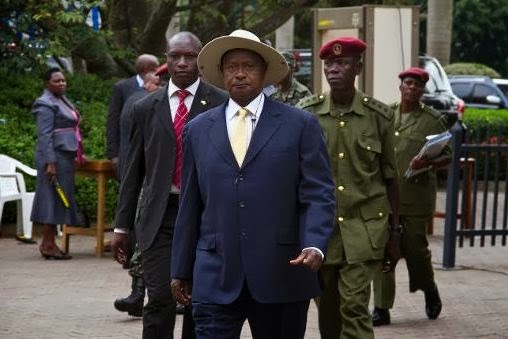
Uganda's President Yoweri Museveni (C) arrives at Munyonyo resort Hotel in Kampala on November 30, 2013 to attend the 15th Ordinary Summit of the East African Community Heads of State (AFP, Isaac Kasamani)
KAMPALA, Uganda—Heads of state in East Africa on Saturday signed a monetary-union deal, setting the clock on a 10-year timeline for the establishment of a regional single currency.
The agreement, reached at the lakeside resort of Munyonyo in Kampala, came after nearly a decade of talks. Kenya, Uganda, Tanzania and Rwanda will now try to establish institutions—including a regional central bank and a statistics body—to support the single currency.
The deal marks an important touchstone in the region's transition from a collection of conflict zones to one of the world's most promising destinations for investment.
"East African community is now fully embarked on enormous, ambitious and transformational initiatives for our people," said Uhuru Kenyatta, Kenya's president and new head of the regional block. "The promise of prosperity and economic development hinges on soundness of our integration."
After establishing the Customs Union in 2005, and the Common Market in 2010, East African countries have reached the third stage toward a united political federation: the Monetary Union Protocol.
But experts have also voiced concerns. "There remain a number of uncertainties about whether these countries can fully put in place a monetary union," said Oswald Leo, an economist at the East African Development Bank.
With a total population of about 135 million people, East Africa is becoming an investment magnet following a flurry of natural-gas and oil discoveries. Uganda and Kenya have discovered huge amounts of oil, while Tanzania boasts of huge natural-gas reserves. International companies have already started exploiting these resources, and the region is poised to become the next major energy hub in Sub Saharan Africa.
Member states will also establish the East African Monetary Institute, which will take charge of all the monetary and exchange-rate policies, while the statistics body will produce regular inflation figures to guide price stabilization.
In October, Uganda, Kenya and Rwanda signed a Single Customs Territory deal, allowing free movement of goods and services across their borders. They have also signed a number of infrastructure deals to put in place regional oil pipelines and a crossborder railway line, rattling Tanzania and Burundi. Early this week, Tanzania demanded that the deals be reviewed to be given a regional appeal.
"This separate coalition poses the risk to disintegrate the community rather than integrate it," said Samuel Sitta, Tanzania's minister in charge of the East African Cooperation.
Shem Bagaine, Uganda's minister in charge of the East African Community, said that all member states including Tanzania "have reaffirmed" their commitment to the integration following the heads-of-state summit in Kampala.
East African Community website [http://www.eac.int/index.php], "One People One Destiny!"
"AFRICOM Posture Statement: Ward reports annual testimony to Congress"
2010-03-10 by "US Africa Command" [http://www.army.mil/article/35595/]:
NATURAL FIRE, Uganda -
In October 2009, U.S. Africa Command, with U.S. Army Africa (USARAF) as the lead component, brought together more than 1,200 soldiers and civilians from six countries for Exercise NATURAL FIRE 10 in Uganda. The exercise improved inter-operability and helped build African partner capacity to respond to complex humanitarian emergencies. The region jointly exercised contingency plans designed to address a global health threat of pandemic influenza. Approximately 550 U.S. personnel and 650 soldiers from Burundi, Kenya, Rwanda, Tanzania, and Uganda participated.
U.S. Naval Forces, Africa (NAVAF), is building on the success of the APS in West Africa by conducting similar activities in East Africa. APS-East will work to build our African partners' capabilities in small boat operations. Our partners include Kenya, Mozambique, the Seychelles, Mauritius, and Tanzania. The activities of the USS BRADLEY and the USS ARLEIGH BURKE in 2009 served as a pilot deployment for APS-East and made great inroads in South and East Africa. In addition, the Combined Joint Task Force - Horn of Africa (CJTF-HOA) established a maritime center of excellence in Mombasa, Kenya, to provide maritime training to African states. Both DOS and DOD approved a Section 1206 (Fiscal Year 06 National Defense Authorization Act, as amended) program to provide small boats, AIS, and surface search radars to Djibouti, Mozambique, Kenya, Tanzania, the Seychelles, Mauritius, and Comoros. The latter effort will establish a basic surveillance capability along the entire East African coast.
Building Capacity of Partner Enabling Forces -
Enablers such as logistics, intelligence, communications, and de-mining capabilities play vital roles in the U.S. military, and facilitate our ability to sustain operations independently. Developing similar enablers or enabling capabilities among African countries can help reduce their dependence on foreign assistance when conducting military operations. Many of our capacity building activities in this area add tremendous value while requiring only a minimal commitment of U.S. personnel.
Counter-terrorism Efforts in East Africa -
In East Africa, U.S. Africa Command's CJTF-HOA conducts operations to counter violent extremists throughout the region to protect U.S. and coalition interests. In cooperation with other USG departments and agencies, CJTF-HOA focuses its operations on building regional security capacity to combat terrorism, deny safe havens, and reduce support to violent extremist organizations. It accomplishes these objectives through the use of Civil Affairs Teams, Seabee construction teams, military advisors, and by importing security courses of instruction.
U.S. Africa Command has focused the majority of its CT capacity building activities in East Africa on Kenya, Ethiopia, Djibouti, and Uganda, which-aside from Somalia-are the countries directly threatened by terrorists. For example, in Kenya, the Command is assisting in establishing a Ranger Strike Force and a Special Boat Unit, which will become the country's primary CT and border security forces. SOCAFRICA completed training two companies of the Kenyan Ranger Strike Force, and our Special Operations Forces (SOF) maritime efforts have created a nascent Kenyan Special Boat Unit capability to enhance Kenyan maritime security. When completed, Kenya will have a significantly improved capacity to counter the terrorist threat emanating from Somalia.
The Uganda People's Defence Forces (UPDF) is one of the region's most professional militaries. It is a reliable partner in combating terrorism and, in collaboration with regional partners, is leading operations against the Lord's Resistance Army. Uganda's peacekeeping force in Somalia has played a critical role in providing the TFG an opportunity to establish itself. U.S. Africa Command and CJTF-HOA continue to work with the UPDF to enhance peacekeeping and CT capabilities through Africa Contingency Operations Training Assistance (ACOTA), IMET, and PKO funded training.
"East African Community"
from the Office of the United States Trade Representative of the Executive Office of the President [http://www.ustr.gov/countries-regions/africa/regional-economic-communities-rec/east-african-community]:
The EAC is one of the leading regional economic organizations in sub-Saharan Africa and has made great strides in recent years toward integrating the economies of its member states. It has established a free trade area and a customs union and is working toward a common market.
On July 16, 2008, the United States and the East African Community (EAC) signed a United States-EAC TIFA in Washington, DC. Trade ministers and other senior officials from the five EAC member states - Burundi, Kenya, Rwanda, Tanzania, and Uganda - witnessed the signing.
The purpose of the TIFA is to strengthen the United States-EAC trade and investment relationship, expand and diversify bilateral trade, and improve the climate for business between U.S. and East African firms. The United States-EAC TIFA establishes regular, high-level talks on the full spectrum of United States-EAC trade and investment topics, including the African Growth and Opportunity Act (AGOA), the World Trade Organization's Doha Round, trade facilitation issues, and trade capacity building assistance.
U.S.-EAC Trade Facts -
The United States has $1.4 billion in total (two way) goods trade with the Eastern African Community (EAC) during 2009. Exports totaled $974 million; Imports totaled $384 billion; The U.S. goods trade surplus with the EAC was $590 million in 2009
Exports -
U.S. goods exports to the EAC in 2009 were $974 million, up 33.9% ($246 million) from 2009.
EAC countries combined would have been the United States' 74th largest goods export market in 2009.
The U.S. export markets in EAC for 2009 were: Kenya ($654 million), Tanzania ($158 million), Uganda ($119 million), Rwanda ($34 million), and Burundi ($9 million).
The top export categories (2-digit HS) in 2009 were: Aircraft ($255 million), Machinery ($122 million), Fertilizers ($120 million), Cereals (corn) ($89 million), and Electrical Machinery ($46 million).
U.S. exports of agricultural products to EAC countries totaled $207 million in 2009. Leading categories include: coarse grains ($78 million), pulses ($29 million), and vegetable oils (excluding soybean oil) ($17 million).
Imports -
U.S. goods imports from the EAC countries totaled $384 million in 2009, down 18% ($85 million) from 2009.
EAC countries combined would have been the United States= 92nd largest goods import supplier in 2009.
The U.S. import suppliers from the EAC for 2009 were: Kenya ($281 million), Tanzania ($49 million), Uganda ($31 million), Rwanda ($19 million), and Burundi ($4 million).
The five largest import categories in 2009 were: Woven Apparel ($100 million), Spices, Coffee, and Tea (mostly coffee) ($98 million), Knit Apparel ($96 million), Edible Fruit and Nuts (cashews) ($11 million), and Special Other (returns) ($10 million).
U.S. imports of agricultural products from EAC countries totaled $136 million in 2009. Leading category include: coffee (unroasted) ($86 million).
Balance of Merchandise Trade -
The U.S. goods trade surplus with EAC was $ 590 million in 2009, a 128% increase ($331 million) over 2008.
Investment -
U.S. foreign direct investment (FDI) in EAC (stock) was $185 million in 2008 (latest data available), down 5.1% from 2007.
"East Africa Takes Step Toward Single Currency; Heads of State Reach Agreement for Monetary Union"
2013-11-30 by Nicholas Bariyo [http://online.wsj.com/news/articles/SB10001424052702303332904579230004056818752]:
Uganda's President Yoweri Museveni (C) arrives at Munyonyo resort Hotel in Kampala on November 30, 2013 to attend the 15th Ordinary Summit of the East African Community Heads of State (AFP, Isaac Kasamani)
KAMPALA, Uganda—Heads of state in East Africa on Saturday signed a monetary-union deal, setting the clock on a 10-year timeline for the establishment of a regional single currency.
The agreement, reached at the lakeside resort of Munyonyo in Kampala, came after nearly a decade of talks. Kenya, Uganda, Tanzania and Rwanda will now try to establish institutions—including a regional central bank and a statistics body—to support the single currency.
The deal marks an important touchstone in the region's transition from a collection of conflict zones to one of the world's most promising destinations for investment.
"East African community is now fully embarked on enormous, ambitious and transformational initiatives for our people," said Uhuru Kenyatta, Kenya's president and new head of the regional block. "The promise of prosperity and economic development hinges on soundness of our integration."
After establishing the Customs Union in 2005, and the Common Market in 2010, East African countries have reached the third stage toward a united political federation: the Monetary Union Protocol.
But experts have also voiced concerns. "There remain a number of uncertainties about whether these countries can fully put in place a monetary union," said Oswald Leo, an economist at the East African Development Bank.
With a total population of about 135 million people, East Africa is becoming an investment magnet following a flurry of natural-gas and oil discoveries. Uganda and Kenya have discovered huge amounts of oil, while Tanzania boasts of huge natural-gas reserves. International companies have already started exploiting these resources, and the region is poised to become the next major energy hub in Sub Saharan Africa.
Member states will also establish the East African Monetary Institute, which will take charge of all the monetary and exchange-rate policies, while the statistics body will produce regular inflation figures to guide price stabilization.
In October, Uganda, Kenya and Rwanda signed a Single Customs Territory deal, allowing free movement of goods and services across their borders. They have also signed a number of infrastructure deals to put in place regional oil pipelines and a crossborder railway line, rattling Tanzania and Burundi. Early this week, Tanzania demanded that the deals be reviewed to be given a regional appeal.
"This separate coalition poses the risk to disintegrate the community rather than integrate it," said Samuel Sitta, Tanzania's minister in charge of the East African Cooperation.
Shem Bagaine, Uganda's minister in charge of the East African Community, said that all member states including Tanzania "have reaffirmed" their commitment to the integration following the heads-of-state summit in Kampala.
Subscribe to:
Posts (Atom)