"Nigeria's leader under fire over missing $50B in oil money"
2013-12-12 from "UPI" newswire:
Abuja, Nigeria -
President Goodluck Jonathan is under growing pressure from top-level corruption in Nigeria's oil industry, with the central bank asking what happened to $50 billion in missing oil revenues and his political mentor, former president Gen. Olusegun Obasanjo complaining about massive fraud in the industry.
Meantime, massive oil theft in the Niger Delta, the southern region where Nigeria's oil production is centered, is rising amid reports of growing politicization of militants who have been blamed for much of the theft in recent years.
They have threatened to bring oil production to a halt by 2015 unless the government and foreign oil companies compensate impoverished villagers for massive environmental damage in the region and introduce more equitable sharing of oil revenue.
The multifaceted oil issue is becoming a major problem for Jonathan, who hails from the Christian south himself, and is currently grappling with a mushrooming Islamist insurrection in the Muslim north.
He has been under growing public pressure for failing to take effective action against official corruption.
The West African state, whose 150 million people are roughly evenly split between Muslims and Christians, was once Africa's energy powerhouse.
But now it's losing an average of $5 billion a year in potential revenue because of sabotage and international criminal networks who are stealing around 150,000 barrels of crude oil a day.
The Royal Institute of International Affairs, a London think tank, reported in September this has reduced oil production to a four-year low of slightly less than 2 million barrels per day.
The massive theft costs the continent's second largest economy after South Africa as much as $1 billion a month.
Oil revenues provide around 80 percent of the state budget.
"Rampant corruption means little of this revenue actually makes its way back to the Niger Delta communities that host the industry, encouraging extortion and oil theft as alternative revenue streams," observed the Jamestown Foundation, a Washington think tank.
This is also incensing militants of the Movement for the Emancipation of the Niger Delta who have been waging an insurgency since 2005 and are now resurgent after a 2009 government amnesty halted their operations for a time in the labyrinthine creeks and swamps of the delta where foreign oil companies operate.
The massive and systematic oil theft, bolstered by deep-rooted official corruption in the West African producer involving well-connected officials and security personnel is fueling instability in the south amid the carnage taking place in the north.
The complaints by the Central Bank of Nigeria and Obasanjo, who's also leader of the ruling People's Democratic Party, have battered Jonathan at a critical time, as he seeks re-election in early 2015.
Previous polls were preceded by sharp increases in spending and official largess as politicians sought to buy their way to power.
In October, Nigeria launched a campaign to pressure Lichtenstein to return $254.7 million stashed by former military dictator Gen. Sani Abacha, the most brutal of Nigeria's military rulers.
The funds are still stashed in the tiny European principality 14 years after recovery proceedings began following Abacha's death in 1998.
A leaked text of the central bank's letter to Jonathan says the state oil company has failed to account for nearly $50 billion in crude oil sold from January 2012 to July 2013 that should have been remitted to government coffers.
The Financial Times reported the shortfall added up to 76 percent of crude sold by the Nigerian National Petroleum Corp. and is nearly equal to federal budget expenditure for both years. The NNPC rejects the allegations.
Obasanjo said he felt compelled to confront Jonathan with his complaints -- which may have more to do with pre-election positioning than genuine outrage at the massive rip-off of state funds -- out of "serious concern" about the direction in which Africa's most populous nation is heading under the man he helped propel to high office.
He urged his former protege to stand down "before it is too late" -- read: save the party embarrassment at the polls -- in the interests of national unity.
In his 18-page letter, Obasanjo trotted out a litany of alleged fiscal abuses in government that included the sale of 430,000 barrels of oil he says were not remitted to federal coffers.
Friday, December 13, 2013

Monday, December 9, 2013
USA Military aircraft sent into combat alongside France's Military in Central Africa Republic
News and info about the imperialist conquest in the Central Africa Republic [link]
"U.S. military aircraft to aid Central African Republic mission"
2013-12-09 by CNN Pentagon Correspondent Barbara Starr [http://security.blogs.cnn.com/2013/12/09/u-s-military-aircraft-to-aid-central-african-republic-mission/]:
American military aircraft will fly African and European peacekeepers to the Central African Republic, which is in the midst of a bloody internal conflict between various proclaimed Christian and Muslim militias and other rebel factions.
The decision announced the Pentagon was followed by a statement from President Barack Obama, who called on the country's citizens to reject violence and urged the transitional government to join "respected leaders" in Muslim and Christian communities in calling for "calm and peace."
"Individuals who are engaging in violence must be held accountable in accordance with the law. Meanwhile, as forces from other African countries and France work to restore security, the United States will support their efforts to protect civilians," Obama said.
Pentagon spokesman Carl Woog said "the United States is joining the international community" in aiding the peackeeping effort "because of our belief that immediate action is required to avert a humanitarian and human rights catastrophe."
Defense Secretary Chuck Hagel responded after talking with his French counterpart, Yves Le Drian, on Sunday from Afghanistan, Woog said, adding that France asked for "limited assistance."
The request for near term help involves U.S. air support to enable the prompt deployment of African forces "to prevent the further spread of sectarian violence," Woog said.
Violence has raged in the former French colony east of Cameroon since a coalition of rebels deposed President Francois Bozize in March. It was the latest in a series of coups since the nation gained independence. Bozize fled the country after his ouster.
Left uncontrolled, militia groups are uniting along religious lines. Christian vigilante groups have formed to battle Seleka, the predominantly Muslim coalition behind the President's removal.
More than 400,000 people - nearly 10% of the population - have been internally displaced, according to the United Nations.
The U.N. Security Council unanimously approved a resolution last week authorizing military intervention by an African Union-led force backed by French troops to protect civilians, restore humanitarian access and stabilize the country.
As part of the effort, the United States will fly troops from Burundi to the Central African Republic capital of Bangui.
The Pentagon will provide security for its planes, but there is no indication about the number of troops involved. The operation is expected to be relatively small.
Violence on the ground, which has included machetes, knives, rifles and grenades, will be a "big factor" in any U.S. operation, a U.S. official told CNN.
"It's a concern," the official said.
French President Francois Hollande said in Paris over the weekend that the goal is to hold elections once security is restored.
Those displaced include people hiding in the bush without shelter, food, or drinking water, Doctors Without Borders has said.
In a statement on Monday, the international medical organization called for all parties to let the wounded and sick "safely obtain medical care," and for "an end to violence and threats against patients, civilians, and medical staff" nationwide.
"U.S. military aircraft to aid Central African Republic mission"
2013-12-09 by CNN Pentagon Correspondent Barbara Starr [http://security.blogs.cnn.com/2013/12/09/u-s-military-aircraft-to-aid-central-african-republic-mission/]:
American military aircraft will fly African and European peacekeepers to the Central African Republic, which is in the midst of a bloody internal conflict between various proclaimed Christian and Muslim militias and other rebel factions.
The decision announced the Pentagon was followed by a statement from President Barack Obama, who called on the country's citizens to reject violence and urged the transitional government to join "respected leaders" in Muslim and Christian communities in calling for "calm and peace."
"Individuals who are engaging in violence must be held accountable in accordance with the law. Meanwhile, as forces from other African countries and France work to restore security, the United States will support their efforts to protect civilians," Obama said.
Pentagon spokesman Carl Woog said "the United States is joining the international community" in aiding the peackeeping effort "because of our belief that immediate action is required to avert a humanitarian and human rights catastrophe."
Defense Secretary Chuck Hagel responded after talking with his French counterpart, Yves Le Drian, on Sunday from Afghanistan, Woog said, adding that France asked for "limited assistance."
The request for near term help involves U.S. air support to enable the prompt deployment of African forces "to prevent the further spread of sectarian violence," Woog said.
Violence has raged in the former French colony east of Cameroon since a coalition of rebels deposed President Francois Bozize in March. It was the latest in a series of coups since the nation gained independence. Bozize fled the country after his ouster.
Left uncontrolled, militia groups are uniting along religious lines. Christian vigilante groups have formed to battle Seleka, the predominantly Muslim coalition behind the President's removal.
More than 400,000 people - nearly 10% of the population - have been internally displaced, according to the United Nations.
The U.N. Security Council unanimously approved a resolution last week authorizing military intervention by an African Union-led force backed by French troops to protect civilians, restore humanitarian access and stabilize the country.
As part of the effort, the United States will fly troops from Burundi to the Central African Republic capital of Bangui.
The Pentagon will provide security for its planes, but there is no indication about the number of troops involved. The operation is expected to be relatively small.
Violence on the ground, which has included machetes, knives, rifles and grenades, will be a "big factor" in any U.S. operation, a U.S. official told CNN.
"It's a concern," the official said.
French President Francois Hollande said in Paris over the weekend that the goal is to hold elections once security is restored.
Those displaced include people hiding in the bush without shelter, food, or drinking water, Doctors Without Borders has said.
In a statement on Monday, the international medical organization called for all parties to let the wounded and sick "safely obtain medical care," and for "an end to violence and threats against patients, civilians, and medical staff" nationwide.
Sunday, December 1, 2013
East African Community
USA AfriCom provides security for oil shipments, especially from Kenyan pipelines.
East African Community website [http://www.eac.int/index.php], "One People One Destiny!"
"AFRICOM Posture Statement: Ward reports annual testimony to Congress"
2010-03-10 by "US Africa Command" [http://www.army.mil/article/35595/]:
NATURAL FIRE, Uganda -
In October 2009, U.S. Africa Command, with U.S. Army Africa (USARAF) as the lead component, brought together more than 1,200 soldiers and civilians from six countries for Exercise NATURAL FIRE 10 in Uganda. The exercise improved inter-operability and helped build African partner capacity to respond to complex humanitarian emergencies. The region jointly exercised contingency plans designed to address a global health threat of pandemic influenza. Approximately 550 U.S. personnel and 650 soldiers from Burundi, Kenya, Rwanda, Tanzania, and Uganda participated.
U.S. Naval Forces, Africa (NAVAF), is building on the success of the APS in West Africa by conducting similar activities in East Africa. APS-East will work to build our African partners' capabilities in small boat operations. Our partners include Kenya, Mozambique, the Seychelles, Mauritius, and Tanzania. The activities of the USS BRADLEY and the USS ARLEIGH BURKE in 2009 served as a pilot deployment for APS-East and made great inroads in South and East Africa. In addition, the Combined Joint Task Force - Horn of Africa (CJTF-HOA) established a maritime center of excellence in Mombasa, Kenya, to provide maritime training to African states. Both DOS and DOD approved a Section 1206 (Fiscal Year 06 National Defense Authorization Act, as amended) program to provide small boats, AIS, and surface search radars to Djibouti, Mozambique, Kenya, Tanzania, the Seychelles, Mauritius, and Comoros. The latter effort will establish a basic surveillance capability along the entire East African coast.
Building Capacity of Partner Enabling Forces -
Enablers such as logistics, intelligence, communications, and de-mining capabilities play vital roles in the U.S. military, and facilitate our ability to sustain operations independently. Developing similar enablers or enabling capabilities among African countries can help reduce their dependence on foreign assistance when conducting military operations. Many of our capacity building activities in this area add tremendous value while requiring only a minimal commitment of U.S. personnel.
Counter-terrorism Efforts in East Africa -
In East Africa, U.S. Africa Command's CJTF-HOA conducts operations to counter violent extremists throughout the region to protect U.S. and coalition interests. In cooperation with other USG departments and agencies, CJTF-HOA focuses its operations on building regional security capacity to combat terrorism, deny safe havens, and reduce support to violent extremist organizations. It accomplishes these objectives through the use of Civil Affairs Teams, Seabee construction teams, military advisors, and by importing security courses of instruction.
U.S. Africa Command has focused the majority of its CT capacity building activities in East Africa on Kenya, Ethiopia, Djibouti, and Uganda, which-aside from Somalia-are the countries directly threatened by terrorists. For example, in Kenya, the Command is assisting in establishing a Ranger Strike Force and a Special Boat Unit, which will become the country's primary CT and border security forces. SOCAFRICA completed training two companies of the Kenyan Ranger Strike Force, and our Special Operations Forces (SOF) maritime efforts have created a nascent Kenyan Special Boat Unit capability to enhance Kenyan maritime security. When completed, Kenya will have a significantly improved capacity to counter the terrorist threat emanating from Somalia.
The Uganda People's Defence Forces (UPDF) is one of the region's most professional militaries. It is a reliable partner in combating terrorism and, in collaboration with regional partners, is leading operations against the Lord's Resistance Army. Uganda's peacekeeping force in Somalia has played a critical role in providing the TFG an opportunity to establish itself. U.S. Africa Command and CJTF-HOA continue to work with the UPDF to enhance peacekeeping and CT capabilities through Africa Contingency Operations Training Assistance (ACOTA), IMET, and PKO funded training.
"East African Community"
from the Office of the United States Trade Representative of the Executive Office of the President [http://www.ustr.gov/countries-regions/africa/regional-economic-communities-rec/east-african-community]:
The EAC is one of the leading regional economic organizations in sub-Saharan Africa and has made great strides in recent years toward integrating the economies of its member states. It has established a free trade area and a customs union and is working toward a common market.
On July 16, 2008, the United States and the East African Community (EAC) signed a United States-EAC TIFA in Washington, DC. Trade ministers and other senior officials from the five EAC member states - Burundi, Kenya, Rwanda, Tanzania, and Uganda - witnessed the signing.
The purpose of the TIFA is to strengthen the United States-EAC trade and investment relationship, expand and diversify bilateral trade, and improve the climate for business between U.S. and East African firms. The United States-EAC TIFA establishes regular, high-level talks on the full spectrum of United States-EAC trade and investment topics, including the African Growth and Opportunity Act (AGOA), the World Trade Organization's Doha Round, trade facilitation issues, and trade capacity building assistance.
U.S.-EAC Trade Facts -
The United States has $1.4 billion in total (two way) goods trade with the Eastern African Community (EAC) during 2009. Exports totaled $974 million; Imports totaled $384 billion; The U.S. goods trade surplus with the EAC was $590 million in 2009
Exports -
U.S. goods exports to the EAC in 2009 were $974 million, up 33.9% ($246 million) from 2009.
EAC countries combined would have been the United States' 74th largest goods export market in 2009.
The U.S. export markets in EAC for 2009 were: Kenya ($654 million), Tanzania ($158 million), Uganda ($119 million), Rwanda ($34 million), and Burundi ($9 million).
The top export categories (2-digit HS) in 2009 were: Aircraft ($255 million), Machinery ($122 million), Fertilizers ($120 million), Cereals (corn) ($89 million), and Electrical Machinery ($46 million).
U.S. exports of agricultural products to EAC countries totaled $207 million in 2009. Leading categories include: coarse grains ($78 million), pulses ($29 million), and vegetable oils (excluding soybean oil) ($17 million).
Imports -
U.S. goods imports from the EAC countries totaled $384 million in 2009, down 18% ($85 million) from 2009.
EAC countries combined would have been the United States= 92nd largest goods import supplier in 2009.
The U.S. import suppliers from the EAC for 2009 were: Kenya ($281 million), Tanzania ($49 million), Uganda ($31 million), Rwanda ($19 million), and Burundi ($4 million).
The five largest import categories in 2009 were: Woven Apparel ($100 million), Spices, Coffee, and Tea (mostly coffee) ($98 million), Knit Apparel ($96 million), Edible Fruit and Nuts (cashews) ($11 million), and Special Other (returns) ($10 million).
U.S. imports of agricultural products from EAC countries totaled $136 million in 2009. Leading category include: coffee (unroasted) ($86 million).
Balance of Merchandise Trade -
The U.S. goods trade surplus with EAC was $ 590 million in 2009, a 128% increase ($331 million) over 2008.
Investment -
U.S. foreign direct investment (FDI) in EAC (stock) was $185 million in 2008 (latest data available), down 5.1% from 2007.
"East Africa Takes Step Toward Single Currency; Heads of State Reach Agreement for Monetary Union"
2013-11-30 by Nicholas Bariyo [http://online.wsj.com/news/articles/SB10001424052702303332904579230004056818752]:
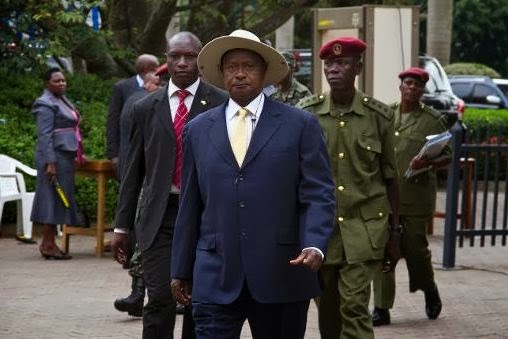
Uganda's President Yoweri Museveni (C) arrives at Munyonyo resort Hotel in Kampala on November 30, 2013 to attend the 15th Ordinary Summit of the East African Community Heads of State (AFP, Isaac Kasamani)
KAMPALA, Uganda—Heads of state in East Africa on Saturday signed a monetary-union deal, setting the clock on a 10-year timeline for the establishment of a regional single currency.
The agreement, reached at the lakeside resort of Munyonyo in Kampala, came after nearly a decade of talks. Kenya, Uganda, Tanzania and Rwanda will now try to establish institutions—including a regional central bank and a statistics body—to support the single currency.
The deal marks an important touchstone in the region's transition from a collection of conflict zones to one of the world's most promising destinations for investment.
"East African community is now fully embarked on enormous, ambitious and transformational initiatives for our people," said Uhuru Kenyatta, Kenya's president and new head of the regional block. "The promise of prosperity and economic development hinges on soundness of our integration."
After establishing the Customs Union in 2005, and the Common Market in 2010, East African countries have reached the third stage toward a united political federation: the Monetary Union Protocol.
But experts have also voiced concerns. "There remain a number of uncertainties about whether these countries can fully put in place a monetary union," said Oswald Leo, an economist at the East African Development Bank.
With a total population of about 135 million people, East Africa is becoming an investment magnet following a flurry of natural-gas and oil discoveries. Uganda and Kenya have discovered huge amounts of oil, while Tanzania boasts of huge natural-gas reserves. International companies have already started exploiting these resources, and the region is poised to become the next major energy hub in Sub Saharan Africa.
Member states will also establish the East African Monetary Institute, which will take charge of all the monetary and exchange-rate policies, while the statistics body will produce regular inflation figures to guide price stabilization.
In October, Uganda, Kenya and Rwanda signed a Single Customs Territory deal, allowing free movement of goods and services across their borders. They have also signed a number of infrastructure deals to put in place regional oil pipelines and a crossborder railway line, rattling Tanzania and Burundi. Early this week, Tanzania demanded that the deals be reviewed to be given a regional appeal.
"This separate coalition poses the risk to disintegrate the community rather than integrate it," said Samuel Sitta, Tanzania's minister in charge of the East African Cooperation.
Shem Bagaine, Uganda's minister in charge of the East African Community, said that all member states including Tanzania "have reaffirmed" their commitment to the integration following the heads-of-state summit in Kampala.
East African Community website [http://www.eac.int/index.php], "One People One Destiny!"
"AFRICOM Posture Statement: Ward reports annual testimony to Congress"
2010-03-10 by "US Africa Command" [http://www.army.mil/article/35595/]:
NATURAL FIRE, Uganda -
In October 2009, U.S. Africa Command, with U.S. Army Africa (USARAF) as the lead component, brought together more than 1,200 soldiers and civilians from six countries for Exercise NATURAL FIRE 10 in Uganda. The exercise improved inter-operability and helped build African partner capacity to respond to complex humanitarian emergencies. The region jointly exercised contingency plans designed to address a global health threat of pandemic influenza. Approximately 550 U.S. personnel and 650 soldiers from Burundi, Kenya, Rwanda, Tanzania, and Uganda participated.
U.S. Naval Forces, Africa (NAVAF), is building on the success of the APS in West Africa by conducting similar activities in East Africa. APS-East will work to build our African partners' capabilities in small boat operations. Our partners include Kenya, Mozambique, the Seychelles, Mauritius, and Tanzania. The activities of the USS BRADLEY and the USS ARLEIGH BURKE in 2009 served as a pilot deployment for APS-East and made great inroads in South and East Africa. In addition, the Combined Joint Task Force - Horn of Africa (CJTF-HOA) established a maritime center of excellence in Mombasa, Kenya, to provide maritime training to African states. Both DOS and DOD approved a Section 1206 (Fiscal Year 06 National Defense Authorization Act, as amended) program to provide small boats, AIS, and surface search radars to Djibouti, Mozambique, Kenya, Tanzania, the Seychelles, Mauritius, and Comoros. The latter effort will establish a basic surveillance capability along the entire East African coast.
Building Capacity of Partner Enabling Forces -
Enablers such as logistics, intelligence, communications, and de-mining capabilities play vital roles in the U.S. military, and facilitate our ability to sustain operations independently. Developing similar enablers or enabling capabilities among African countries can help reduce their dependence on foreign assistance when conducting military operations. Many of our capacity building activities in this area add tremendous value while requiring only a minimal commitment of U.S. personnel.
Counter-terrorism Efforts in East Africa -
In East Africa, U.S. Africa Command's CJTF-HOA conducts operations to counter violent extremists throughout the region to protect U.S. and coalition interests. In cooperation with other USG departments and agencies, CJTF-HOA focuses its operations on building regional security capacity to combat terrorism, deny safe havens, and reduce support to violent extremist organizations. It accomplishes these objectives through the use of Civil Affairs Teams, Seabee construction teams, military advisors, and by importing security courses of instruction.
U.S. Africa Command has focused the majority of its CT capacity building activities in East Africa on Kenya, Ethiopia, Djibouti, and Uganda, which-aside from Somalia-are the countries directly threatened by terrorists. For example, in Kenya, the Command is assisting in establishing a Ranger Strike Force and a Special Boat Unit, which will become the country's primary CT and border security forces. SOCAFRICA completed training two companies of the Kenyan Ranger Strike Force, and our Special Operations Forces (SOF) maritime efforts have created a nascent Kenyan Special Boat Unit capability to enhance Kenyan maritime security. When completed, Kenya will have a significantly improved capacity to counter the terrorist threat emanating from Somalia.
The Uganda People's Defence Forces (UPDF) is one of the region's most professional militaries. It is a reliable partner in combating terrorism and, in collaboration with regional partners, is leading operations against the Lord's Resistance Army. Uganda's peacekeeping force in Somalia has played a critical role in providing the TFG an opportunity to establish itself. U.S. Africa Command and CJTF-HOA continue to work with the UPDF to enhance peacekeeping and CT capabilities through Africa Contingency Operations Training Assistance (ACOTA), IMET, and PKO funded training.
"East African Community"
from the Office of the United States Trade Representative of the Executive Office of the President [http://www.ustr.gov/countries-regions/africa/regional-economic-communities-rec/east-african-community]:
The EAC is one of the leading regional economic organizations in sub-Saharan Africa and has made great strides in recent years toward integrating the economies of its member states. It has established a free trade area and a customs union and is working toward a common market.
On July 16, 2008, the United States and the East African Community (EAC) signed a United States-EAC TIFA in Washington, DC. Trade ministers and other senior officials from the five EAC member states - Burundi, Kenya, Rwanda, Tanzania, and Uganda - witnessed the signing.
The purpose of the TIFA is to strengthen the United States-EAC trade and investment relationship, expand and diversify bilateral trade, and improve the climate for business between U.S. and East African firms. The United States-EAC TIFA establishes regular, high-level talks on the full spectrum of United States-EAC trade and investment topics, including the African Growth and Opportunity Act (AGOA), the World Trade Organization's Doha Round, trade facilitation issues, and trade capacity building assistance.
U.S.-EAC Trade Facts -
The United States has $1.4 billion in total (two way) goods trade with the Eastern African Community (EAC) during 2009. Exports totaled $974 million; Imports totaled $384 billion; The U.S. goods trade surplus with the EAC was $590 million in 2009
Exports -
U.S. goods exports to the EAC in 2009 were $974 million, up 33.9% ($246 million) from 2009.
EAC countries combined would have been the United States' 74th largest goods export market in 2009.
The U.S. export markets in EAC for 2009 were: Kenya ($654 million), Tanzania ($158 million), Uganda ($119 million), Rwanda ($34 million), and Burundi ($9 million).
The top export categories (2-digit HS) in 2009 were: Aircraft ($255 million), Machinery ($122 million), Fertilizers ($120 million), Cereals (corn) ($89 million), and Electrical Machinery ($46 million).
U.S. exports of agricultural products to EAC countries totaled $207 million in 2009. Leading categories include: coarse grains ($78 million), pulses ($29 million), and vegetable oils (excluding soybean oil) ($17 million).
Imports -
U.S. goods imports from the EAC countries totaled $384 million in 2009, down 18% ($85 million) from 2009.
EAC countries combined would have been the United States= 92nd largest goods import supplier in 2009.
The U.S. import suppliers from the EAC for 2009 were: Kenya ($281 million), Tanzania ($49 million), Uganda ($31 million), Rwanda ($19 million), and Burundi ($4 million).
The five largest import categories in 2009 were: Woven Apparel ($100 million), Spices, Coffee, and Tea (mostly coffee) ($98 million), Knit Apparel ($96 million), Edible Fruit and Nuts (cashews) ($11 million), and Special Other (returns) ($10 million).
U.S. imports of agricultural products from EAC countries totaled $136 million in 2009. Leading category include: coffee (unroasted) ($86 million).
Balance of Merchandise Trade -
The U.S. goods trade surplus with EAC was $ 590 million in 2009, a 128% increase ($331 million) over 2008.
Investment -
U.S. foreign direct investment (FDI) in EAC (stock) was $185 million in 2008 (latest data available), down 5.1% from 2007.
"East Africa Takes Step Toward Single Currency; Heads of State Reach Agreement for Monetary Union"
2013-11-30 by Nicholas Bariyo [http://online.wsj.com/news/articles/SB10001424052702303332904579230004056818752]:
Uganda's President Yoweri Museveni (C) arrives at Munyonyo resort Hotel in Kampala on November 30, 2013 to attend the 15th Ordinary Summit of the East African Community Heads of State (AFP, Isaac Kasamani)
KAMPALA, Uganda—Heads of state in East Africa on Saturday signed a monetary-union deal, setting the clock on a 10-year timeline for the establishment of a regional single currency.
The agreement, reached at the lakeside resort of Munyonyo in Kampala, came after nearly a decade of talks. Kenya, Uganda, Tanzania and Rwanda will now try to establish institutions—including a regional central bank and a statistics body—to support the single currency.
The deal marks an important touchstone in the region's transition from a collection of conflict zones to one of the world's most promising destinations for investment.
"East African community is now fully embarked on enormous, ambitious and transformational initiatives for our people," said Uhuru Kenyatta, Kenya's president and new head of the regional block. "The promise of prosperity and economic development hinges on soundness of our integration."
After establishing the Customs Union in 2005, and the Common Market in 2010, East African countries have reached the third stage toward a united political federation: the Monetary Union Protocol.
But experts have also voiced concerns. "There remain a number of uncertainties about whether these countries can fully put in place a monetary union," said Oswald Leo, an economist at the East African Development Bank.
With a total population of about 135 million people, East Africa is becoming an investment magnet following a flurry of natural-gas and oil discoveries. Uganda and Kenya have discovered huge amounts of oil, while Tanzania boasts of huge natural-gas reserves. International companies have already started exploiting these resources, and the region is poised to become the next major energy hub in Sub Saharan Africa.
Member states will also establish the East African Monetary Institute, which will take charge of all the monetary and exchange-rate policies, while the statistics body will produce regular inflation figures to guide price stabilization.
In October, Uganda, Kenya and Rwanda signed a Single Customs Territory deal, allowing free movement of goods and services across their borders. They have also signed a number of infrastructure deals to put in place regional oil pipelines and a crossborder railway line, rattling Tanzania and Burundi. Early this week, Tanzania demanded that the deals be reviewed to be given a regional appeal.
"This separate coalition poses the risk to disintegrate the community rather than integrate it," said Samuel Sitta, Tanzania's minister in charge of the East African Cooperation.
Shem Bagaine, Uganda's minister in charge of the East African Community, said that all member states including Tanzania "have reaffirmed" their commitment to the integration following the heads-of-state summit in Kampala.
Friday, October 11, 2013
A war against China
Alongside the war against the People of Alkebulan (Africa), the "Trilateral Axis" composed of the USA, the British (Empire) Commonwealth, and Israel, is organizing to limit the influence of rivals over the United Nation Governments stewarding the resources contained in Africa, especially against the "Shanghei Axis" of China [link].

"Old Game, New Obsession, New Enemy: Now it's China"
2013-10-11 by John Pilger from "Truthout" [http://truth-out.org/opinion/item/19349-old-game-new-obsession-new-enemy-now-its-china]:
Countries are "pieces on a chessboard upon which is being played out a great game for the domination of the world," wrote Lord Curzon, viceroy of India, in 1898. Nothing has changed. The shopping mall massacre in Nairobi was a bloody façade behind which a full-scale invasion of Africa and a war in Asia are the great game.
The al-Shabab shopping mall killers came from Somalia. If any country is an imperial metaphor, it is Somalia. Sharing a common language and religion, Somalis have been divided between the British, French, Italians and Ethiopians. Tens of thousands of people have been handed from one power to another. "When they are made to hate each other," wrote a British colonial official, "good governance is assured."
Today, Somalia is a theme park of brutal, artificial divisions, long impoverished by World Bank and IMF "structural adjustment" programs and saturated with modern weapons, notably President Obama's personal favorite, the drone. The one stable Somali government, the Islamic Courts, was "well received by the people in the areas it controlled," reported the US Congressional Research Service, "[but] received negative press coverage, especially in the West." Obama crushed it. And in January, Hillary Clinton, then secretary of state, presented her man to the world. "Somalia will remain grateful to the unwavering support from the United States government," effused President Hassan Mohamud. "Thank you, America."
The shopping mall atrocity was a response to this - just as the attack on the Twin Towers and the London bombings were explicit reactions to invasion and injustice. Once of little consequence, jihadism now marches in lockstep with the return of unfettered imperialism.
Since NATO reduced modern Libya to a Hobbesian state in 2011, the last obstacles to Africa have fallen. "Scrambles for energy, minerals and fertile land are likely to occur with increasingly intensity," Ministry of Defence planners report. They predict "high numbers of civilian casualties"; therefore "perceptions of moral legitimacy will be important for success." Sensitive to the PR problem of invading a continent, the arms mammoth BAE Systems, together with Barclay Capital and BP, warn that "the government should define its international mission as managing risks on behalf of British citizens." The cynicism is lethal. British governments repeatedly are warned, not least by the parliamentary intelligence and security committee, that foreign adventures beckon retaliation at home.
With minimal media interest, the US African Command (Africom) has deployed troops to 35 African countries, establishing a familiar network of authoritarian supplicants eager for bribes and armaments. In war games, a "soldier to soldier" doctrine embeds US officers at every level of command, from general to warrant officer. The British did the same in India. It is as if Africa's proud history of liberation, from Patrice Lumumba to Nelson Mandela, is consigned to oblivion by a new master's black colonial elite whose "historic mission," warned Frantz Fanon half a century ago, is the subjugation of their own people in the cause of "a capitalism rampant though camouflaged." The reference also fits the Son of Africa in the White House.
For Obama, there is a more pressing cause - China. Africa is China's success story. Where the Americans bring drones, the Chinese build roads, bridges and dams. What the Chinese want is resources, especially fossel fuels. NATO's bombing of Libya drove out 30,000 Chinese oil industry workers. More than jihadism or Iran, China is now Washington's obsession in Africa and beyond. This is a "policy" known as the "pivot to Asia," whose threat of world war may be as great as any in the modern era.
This week's meeting in Tokyo of US Secretary of State John Kerry and Defense Secretary Chuck Hagel, with their Japanese counterparts, accelerated the prospect of war with the new imperial rival. Sixty percent of US forces are to be based in Asia by 2020, aimed at China. Japan is re-arming rapidly under the right-wing government of Prime Minister Shinzo Abe, who came to power in December with a pledge to build a "new, strong military" and circumvent the "peace constitution." A US-Japanese anti-ballistic-missile system near Kyoto is directed at China. Using long-range Global Hawk drones, the US has increased its provocations sharply in the East China and South China seas, where Japan and China dispute the ownership of the Senkaku/Diaoyu islands. Advanced vertical-takeoff aircraft are deployed in Japan; their purpose is blitzkrieg.
On the Pacific island of Guam, from which B-52s attacked Vietnam, the biggest military buildup since the Indochina wars includes 9,000 US Marines. In Australia this week, an arms fair and military jamboree that diverted much of Sydney is in keeping with a government propaganda campaign to justify an unprecedented US military buildup from Perth to Darwin, aimed at China. The vast US base at Pine Gap near Alice Springs is, as Edward Snowden disclosed, a hub of US spying in the region and beyond; it also is critical to Obama's worldwide assassinations by drone.
"We have to inform the British to keep them on side," McGeorge Bundy, an assistant US secretary of state, once said. "You in Australia are with us, come what may." Australian forces have long played a mercenary role for Washington. However, there is a hitch. China is Australia's biggest trading partner and is largely responsible for its evasion of the 2008 recession. Without China, there would be no minerals boom, no weekly mining return of up to $1 billion.
The dangers this presents rarely are debated publicly in Australia, where Prime Minister Tony Abbott's patron, Rupert Murdoch, controls 70 percent of the press. Occasionally, anxiety is expressed over the "choice" that the US wants Australia to make. A report by the Australian Strategic Policy Institute warns that any US plan to strike at China would involve "blinding" Chinese surveillance, intelligence and command systems. This would "consequently increase the chances of Chinese nuclear pre-emption ... and a series of miscalculations on both sides if Beijing perceives conventional attacks on its homeland as an attempt to disarm its nuclear capability."
In his address to the nation last month, Obama said, "What makes America different, what makes us exceptional is that we are dedicated to act."
"Old Game, New Obsession, New Enemy: Now it's China"
2013-10-11 by John Pilger from "Truthout" [http://truth-out.org/opinion/item/19349-old-game-new-obsession-new-enemy-now-its-china]:
Countries are "pieces on a chessboard upon which is being played out a great game for the domination of the world," wrote Lord Curzon, viceroy of India, in 1898. Nothing has changed. The shopping mall massacre in Nairobi was a bloody façade behind which a full-scale invasion of Africa and a war in Asia are the great game.
The al-Shabab shopping mall killers came from Somalia. If any country is an imperial metaphor, it is Somalia. Sharing a common language and religion, Somalis have been divided between the British, French, Italians and Ethiopians. Tens of thousands of people have been handed from one power to another. "When they are made to hate each other," wrote a British colonial official, "good governance is assured."
Today, Somalia is a theme park of brutal, artificial divisions, long impoverished by World Bank and IMF "structural adjustment" programs and saturated with modern weapons, notably President Obama's personal favorite, the drone. The one stable Somali government, the Islamic Courts, was "well received by the people in the areas it controlled," reported the US Congressional Research Service, "[but] received negative press coverage, especially in the West." Obama crushed it. And in January, Hillary Clinton, then secretary of state, presented her man to the world. "Somalia will remain grateful to the unwavering support from the United States government," effused President Hassan Mohamud. "Thank you, America."
The shopping mall atrocity was a response to this - just as the attack on the Twin Towers and the London bombings were explicit reactions to invasion and injustice. Once of little consequence, jihadism now marches in lockstep with the return of unfettered imperialism.
Since NATO reduced modern Libya to a Hobbesian state in 2011, the last obstacles to Africa have fallen. "Scrambles for energy, minerals and fertile land are likely to occur with increasingly intensity," Ministry of Defence planners report. They predict "high numbers of civilian casualties"; therefore "perceptions of moral legitimacy will be important for success." Sensitive to the PR problem of invading a continent, the arms mammoth BAE Systems, together with Barclay Capital and BP, warn that "the government should define its international mission as managing risks on behalf of British citizens." The cynicism is lethal. British governments repeatedly are warned, not least by the parliamentary intelligence and security committee, that foreign adventures beckon retaliation at home.
With minimal media interest, the US African Command (Africom) has deployed troops to 35 African countries, establishing a familiar network of authoritarian supplicants eager for bribes and armaments. In war games, a "soldier to soldier" doctrine embeds US officers at every level of command, from general to warrant officer. The British did the same in India. It is as if Africa's proud history of liberation, from Patrice Lumumba to Nelson Mandela, is consigned to oblivion by a new master's black colonial elite whose "historic mission," warned Frantz Fanon half a century ago, is the subjugation of their own people in the cause of "a capitalism rampant though camouflaged." The reference also fits the Son of Africa in the White House.
For Obama, there is a more pressing cause - China. Africa is China's success story. Where the Americans bring drones, the Chinese build roads, bridges and dams. What the Chinese want is resources, especially fossel fuels. NATO's bombing of Libya drove out 30,000 Chinese oil industry workers. More than jihadism or Iran, China is now Washington's obsession in Africa and beyond. This is a "policy" known as the "pivot to Asia," whose threat of world war may be as great as any in the modern era.
This week's meeting in Tokyo of US Secretary of State John Kerry and Defense Secretary Chuck Hagel, with their Japanese counterparts, accelerated the prospect of war with the new imperial rival. Sixty percent of US forces are to be based in Asia by 2020, aimed at China. Japan is re-arming rapidly under the right-wing government of Prime Minister Shinzo Abe, who came to power in December with a pledge to build a "new, strong military" and circumvent the "peace constitution." A US-Japanese anti-ballistic-missile system near Kyoto is directed at China. Using long-range Global Hawk drones, the US has increased its provocations sharply in the East China and South China seas, where Japan and China dispute the ownership of the Senkaku/Diaoyu islands. Advanced vertical-takeoff aircraft are deployed in Japan; their purpose is blitzkrieg.
On the Pacific island of Guam, from which B-52s attacked Vietnam, the biggest military buildup since the Indochina wars includes 9,000 US Marines. In Australia this week, an arms fair and military jamboree that diverted much of Sydney is in keeping with a government propaganda campaign to justify an unprecedented US military buildup from Perth to Darwin, aimed at China. The vast US base at Pine Gap near Alice Springs is, as Edward Snowden disclosed, a hub of US spying in the region and beyond; it also is critical to Obama's worldwide assassinations by drone.
"We have to inform the British to keep them on side," McGeorge Bundy, an assistant US secretary of state, once said. "You in Australia are with us, come what may." Australian forces have long played a mercenary role for Washington. However, there is a hitch. China is Australia's biggest trading partner and is largely responsible for its evasion of the 2008 recession. Without China, there would be no minerals boom, no weekly mining return of up to $1 billion.
The dangers this presents rarely are debated publicly in Australia, where Prime Minister Tony Abbott's patron, Rupert Murdoch, controls 70 percent of the press. Occasionally, anxiety is expressed over the "choice" that the US wants Australia to make. A report by the Australian Strategic Policy Institute warns that any US plan to strike at China would involve "blinding" Chinese surveillance, intelligence and command systems. This would "consequently increase the chances of Chinese nuclear pre-emption ... and a series of miscalculations on both sides if Beijing perceives conventional attacks on its homeland as an attempt to disarm its nuclear capability."
In his address to the nation last month, Obama said, "What makes America different, what makes us exceptional is that we are dedicated to act."
Monday, October 7, 2013
British (Empire) Commonwealth in the Alkebulan
2013-10-07 "Africa's most biodiverse area endangered by UK oil firm: WWF"
from "AFP" newswire:
Paris -
Environmental campaigners WWF filed a complaint on Monday against a British oil company accused of intimidating the local population and endangering wildlife in the oldest nature reserve in Africa.
The wildlife charity claims that Soco International's oil exploration activities in and around Virunga National Park in eastern Democratic Republic of Congo put "people, animals and habitats at risk" and violate international guidelines issued by the Organisation for Economic Co-operation and Development (OECD), in a complaint to that organisation.
"The only way for Soco to come into compliance with the OECD guidelines is for the company to end all exploration in Virunga for good," said Lasse Gustavsson, executive director of conservation at WWF International.
"We urge the company to stop its activities immediately," he said.
Organisations can refer to OECD guidelines on ethical corporate behaviour as a way of piling pressure on companies or even governments.
Soco dismissed the claims as "baseless" on its website, adding it had not yet begun any operational activity and would not do so until impact studies had been completed.
Virunga is one of the world's oldest UN World Heritage sites and is the most environmentally diverse area on the African continent, home to thousands of rhinos and 200 endangered mountain gorillas.
Soco's own assessment of its exploration of the park warns of potential pollution and damage to the fragile animal habitats in Virunga.
The WWF alleges that Soco has used state security to intimidate opponents to its business and says the organisation failed to disclose the true impact of development during consultations with local villagers.
Soco's contract with the Congolese government effectively exempts it from further regulation, the WWF says, calling on the company to also consider the health and livelihoods of 50,000 local residents.
The UK is a founding member of the OECD and the organisation's guidelines have previously been used to put political pressure on the British government.
Anthony Field, a campaigner at WWF-UK, told AFP: "OECD guidelines are the most well-respected standards of good practice for businesses, and are internationally recognised by 45 countries including the UK."
OECD complaints could be "incredibly effective", Field said, giving the example of a 2009 case when mining firm Vedanta Resources was condemned by London for failing to respect the rights of an indigenous group when planning a bauxite mine in the Indian state of Orissa.
Soco said its first environmental impact studies were conducted in "close collaboration" with the Congolese Institute for Nature Conservation, which manages the park.
Saturday, October 5, 2013
The "Shanghai Axis"
Unlike the "Trilateral Axis" (composed of the alliance of the USA, the British "Empire" Commonwealth and Israel) and it's use of military methods to consolidate a monopolized economic hold against the People of Alkebulan, the "Shanghai Axis" is using government funded aid programs and not military conquest. While there are no "good guys" while the indigenous nations of Alkebulan are oppressed, it is a contrast to see the difference between the methods used by the competitors of the "Trilateral Axis" and the "Shanghai Axis", especially the Trilaterist war against China [link].
This page provides examples of how China, the core government of the "Shanghai Axis", conducts it's conquest of Alkebulan.
** China's diplomacy program for Africa is $2 billion over 10 years (2014-05) [link]
** Nigeria signs $1.3 bn power plant deal with China [link]
** China wins $2 billion oil deal in Uganda [link]
China's government is consolidating access to resources for the homeland, and indications show that the personalities guiding the government of China are desperate to keep "economic growth" stabilized and yielding profits.
"China's GDP figures wrong by $610 billion: Report"
2013-10-30 from "AFP" [http://articles.economictimes.indiatimes.com/2013-10-30/news/43528904_1_gdp-growth-rate-yuan-economic-information-daily]:
BEIJING: China's economy would be at least 3.7 trillion yuan ($610 billion) bigger than Beijing thinks if the country's local government statistics were to be believed, state media reported Wednesday.
The Economic Information Daily tallied up gross domestic product (GDP) data from 28 of mainland China's 31 provincial-level authorities, totalling 42.4 trillion yuan for the first nine months of the year.
But the figure for the whole country, already announced by Beijing, is 3.7 trillion yuan lower.
The discrepancy -- which has been in place for more than two decades -- has been widening rapidly in recent years, the Economic Information Daily said.
The reliability of Chinese economic data has long been in doubt as local officials tend to massage the figures upwards in pursuit of promotion and the newspaper, which is run by the official Xinhua news agency, pointed to the same problem.
"Some regions may have inflated the statistics due to their distorted perception of achievements given the fact that the performance assessment of local governments is often linked with GDP growth," the report quoted an unnamed National Bureau of Statistics official as saying.
China's Premier Li Keqiang said in 2007, when he was the governor of Liaoning province, that some Chinese data was "man-made", according to a confidential memo released by the WikiLeaks website in 2010.
He told US diplomats that he focused on only three figures -- electricity consumption, rail cargo volume, and the amount of loans issued -- to evaluate his region's economy, the leaked document showed.
Chinese President Xi Jinping said in June that officials' performance evaluations must not be based "simply on GDP growth rate" but take into account factors such as the environment and improving people's well-being.
This page provides examples of how China, the core government of the "Shanghai Axis", conducts it's conquest of Alkebulan.
** China's diplomacy program for Africa is $2 billion over 10 years (2014-05) [link]
** Nigeria signs $1.3 bn power plant deal with China [link]
** China wins $2 billion oil deal in Uganda [link]
China's government is consolidating access to resources for the homeland, and indications show that the personalities guiding the government of China are desperate to keep "economic growth" stabilized and yielding profits.
"China's GDP figures wrong by $610 billion: Report"
2013-10-30 from "AFP" [http://articles.economictimes.indiatimes.com/2013-10-30/news/43528904_1_gdp-growth-rate-yuan-economic-information-daily]:
BEIJING: China's economy would be at least 3.7 trillion yuan ($610 billion) bigger than Beijing thinks if the country's local government statistics were to be believed, state media reported Wednesday.
The Economic Information Daily tallied up gross domestic product (GDP) data from 28 of mainland China's 31 provincial-level authorities, totalling 42.4 trillion yuan for the first nine months of the year.
But the figure for the whole country, already announced by Beijing, is 3.7 trillion yuan lower.
The discrepancy -- which has been in place for more than two decades -- has been widening rapidly in recent years, the Economic Information Daily said.
The reliability of Chinese economic data has long been in doubt as local officials tend to massage the figures upwards in pursuit of promotion and the newspaper, which is run by the official Xinhua news agency, pointed to the same problem.
"Some regions may have inflated the statistics due to their distorted perception of achievements given the fact that the performance assessment of local governments is often linked with GDP growth," the report quoted an unnamed National Bureau of Statistics official as saying.
China's Premier Li Keqiang said in 2007, when he was the governor of Liaoning province, that some Chinese data was "man-made", according to a confidential memo released by the WikiLeaks website in 2010.
He told US diplomats that he focused on only three figures -- electricity consumption, rail cargo volume, and the amount of loans issued -- to evaluate his region's economy, the leaked document showed.
Chinese President Xi Jinping said in June that officials' performance evaluations must not be based "simply on GDP growth rate" but take into account factors such as the environment and improving people's well-being.
Wednesday, October 2, 2013
USA AFRICOM clandestinely includes African allies who recruit child soldiers
"Obama Quietly Okays Military Aid to Countries That Use Child SoldiersOverrides law banning such aid; critics charge 'Obama becoming an expert at waiving human rights laws'"
2013-10-02 by Sarah Lazare from "Common Dreams" [www.commondreams.org/headline/2013/10/02-5]:
Amid the hoopla of the government shutdown, the White House quietly passed a bill Monday that overrides a law banning military aid to countries that use child soldiers.
The Child Soldiers Prevention Act of 2008 prohibits the U.S. government from providing military assistance to countries that directly use, or support the use of, child soldiers. Built into the law is an option allowing the U.S. president to override the ban if he/she deems it necessary.
On Monday, President Obama issued complete waivers to Yemen, Chad, and South Sudan, opening up those countries to U.S. military aid despite their known use of child soldiers, declaring in a written memorandum it is "in the national interest of the United States" to override the ban.
Obama also granted partial waivers to the Democratic Republic of the Congo and Somalia to allow "International Military Education and Training" and "nonlethal" defense for both countries and "provision of assistance under the Peacekeeping Operations authority for logistical support and troop stipends" in Somalia. According to Think Progress writer Hayes Brown [http://thinkprogress.org/security/2013/10/01/2704611/child-soldier-waivers/], these waivers open the door for military aid for ongoing "peacekeeping" operations in both these countries.
"Obama is becoming an expert at waiving human rights laws," writes Ken Hanly in Digital Journal [http://www.digitaljournal.com/article/359480]. "He waived part of a law last month that banned the US from supplying lethal aid to terrorist groups so he could send aid to Syrian rebels. In the case of Egypt, Obama has refused to call the coup by the armed forces a coup and by doing so does not run afoul of a law that would ban aid to a country where there had been a military coup."
"Human rights are to be promoted but only insofar as they do not conflict with US national interest as understood by the president," he added.Meanwhile, the U.S. government has come under criticism for filling its own military ranks with hundreds of thousands of teenagers, including 17-year-olds who can enlist with parental consent [http://inthesetimes.com/article/3199/americas_child_soldier_problem].
Subscribe to:
Posts (Atom)